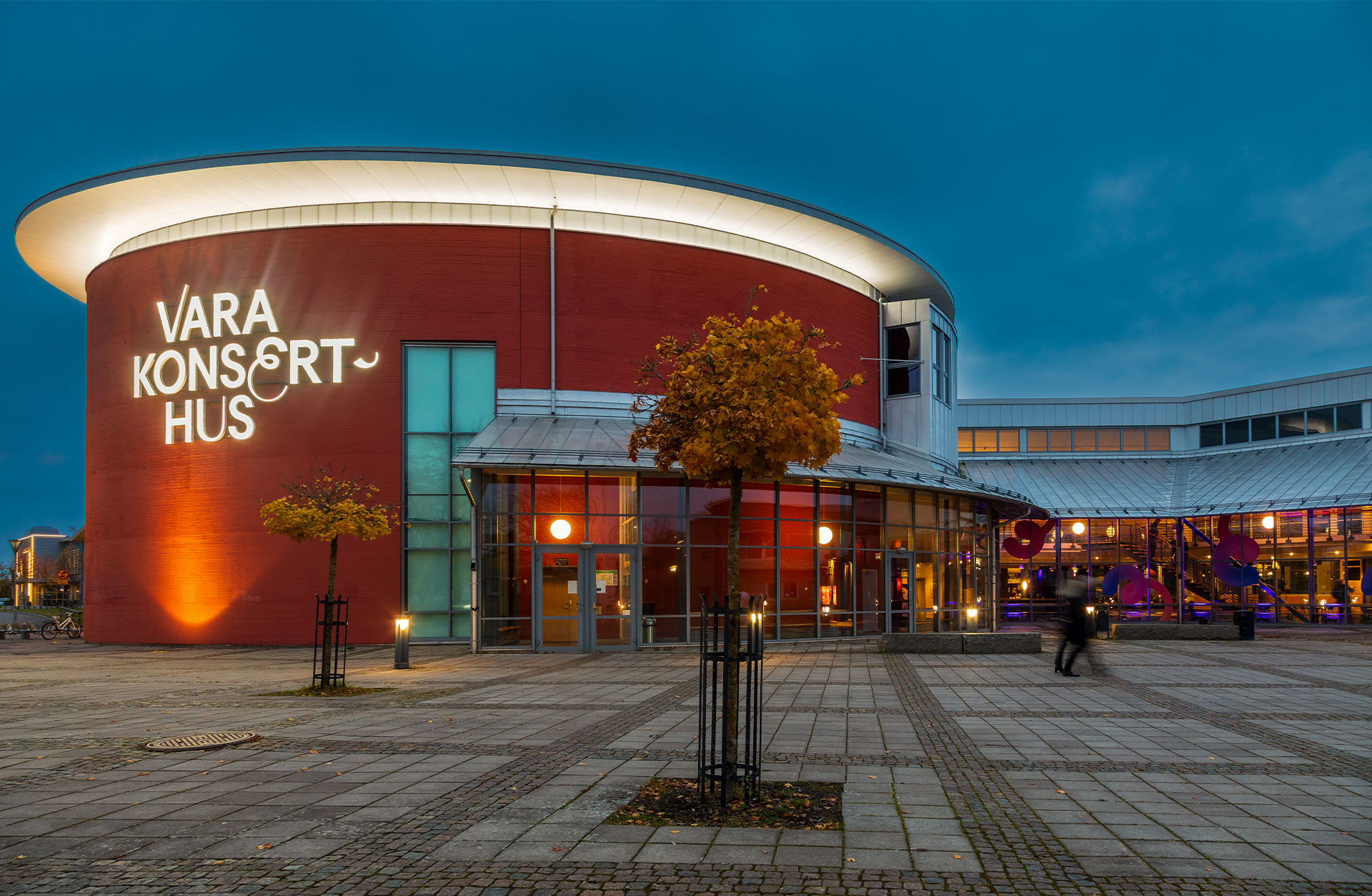
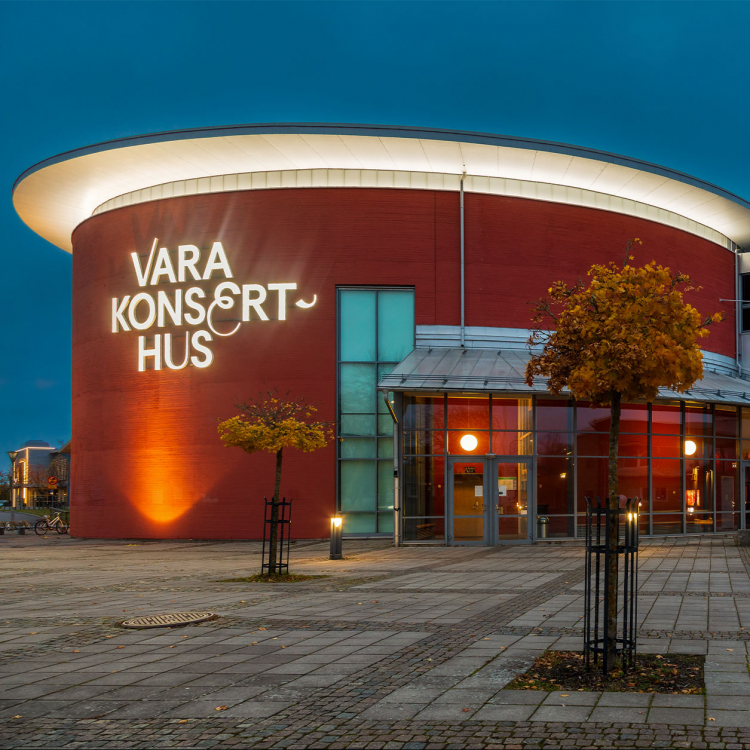
Gothenburg Symphony Orchestra plays in Vara Konserthus together with chief conductor Santtu-Matias Rouvali.
Programme
Joseph Haydn's penultimate symphony no. 103 is nicknamed "The drum roll" after the opening drum roll (which then returns towards the end of the movement). The symphony was composed in Vienna in the winter of 1794-95 and is the eleventh of his London symphonies written to be performed in the city where he was welcomed as a star. In London, Haydn experienced the high point of his entire career and received an appreciation he had never seen before.
The premiere of the last six London symphonies took place at the King's Theater in 1795. The first six had achieved a success London had not seen since Handel's time. Expectations were thus sky high, but neither the audience nor the press left the concert disappointed.
"Drum roll" is composed for what at the time was a large orchestra, around 60 musicians. It begins weakly and ambiguously, as if hesitating between major and minor, foreshadowing Beethoven's and romantic symphonies. Not until the allegro gets underway does the first movement really land in the key of E flat major and blossom into a light and airy theme.
This is followed by a slow andante movement, a minuet and a finale. The finale is one of the longest of all the finales in the London symphonies and – like the first movement of Beethoven's fifth and last of Mozart's Jupiter Symphony – is based on a motive consisting of only four notes.
Carl Magnus Juliusson
Intermission25 min
Igor Stravinsky (1882-1971)
Jeu de cartes
Igor Stravinsky wrote several main works for ballet, including The Firebird, Petrushka and Rite of Spring. Jeu de cartes is also a ballet, composed for the first Stravinsky festival which took place at the Metropolitan Opera in New York in 1937. The title means "Game of cards". A keen poker player himself, Stravinsky had been harboring the idea of composing a ballet based on playing cards for more than a decade.
The ballet consists of three parts that begin with an opening in the form of a grand fanfare. The main role is played by a joker who feels invincible due to his ability to transform into any card. At the beginning of each hand, the cards are shuffled and then played between the participants. All the while the game is interrupted by the joker - but who in the end sees himself defeated by a royal flush of hearts.
Jeu de cartes was written during Stravinsky's neoclassical period which began with Pulcinella in 1920 and after Jeu de cartes continues with, among other things, Symphony in C and the opera The Rake's Progress. During the course of the card game, we also encounter a lot of examples of musical "bluffing". Stravinsky parodies and combines everything from the overture to Rossini's The Barber of Seville and Johann Strauss's Die Fledermaus with small allusions to Beethoven, Tchaikovsky, Ravel and Debussy.
Carl Magnus Juliusson
The glory days of the Viennese waltz at the end of the 19th century were pure madness - completely comparable to today's unrestrained club dancing. Swirling around giant ballrooms with thousands of other couples, over and over again, was the great pleasure and enjoyment of the time. The young loved to be swept up in these communal excesses while the opposing side argued that it was harmful and immoral to spin around in this way. But the Viennese waltz could not be stopped - the Strauss family and their successors spread the courage to the rest of Europe, Russia and the USA.
Ravel was born early enough to know the ravages of the Viennese waltz. This familiarity probably inspired him when he began the orchestral piece intended for Diaghilev's Russian ballet. However, he refused. The "choreographic poem" that was finished in 1920 only became a ballet in 1929 when the dancer Ida Rubinstein staged it. The work's working name was Vienna, a city Ravel knew well by the way, but in the end was given an even more stripped-down and concentrated title: La valse, the waltz. Ravel wrote in the score:
"Dancing couples are glimpsed in the gaps between swirling clouds. The clouds gradually disperse and one can make out a huge ballroom with a swirling crowd. The scene gradually becomes clearer. The flames of the candelabra flare up at the fortissimo. An imperial court, circa 1855."
Like the Strauss waltzes, La valse has a slow opening, after which it finds its rhythm and melody and dances away in good old three-bar. But where Strauss keep the music under soft reins and gently slow down at the end to let off their travelers, Ravel does the opposite: the waltz completely explodes, swells over all borders and explodes both tempo and melody. Ravel simply captures the essence of the Viennese waltz - the rapture and total indulgence. An emotional discharge, or for the theorist: music that comments on itself. The ironic Ravel did not deny himself - what is wrong with satisfying different tastes at the same time?
Thursday, 3 October 2024: The event ends at approx. 21.00
Participants
The Gothenburg Symphony was formed in 1905 and today consists of 109 musicians. The orchestra's base is Göteborgs Konserthus, the funk gem at Götaplatsen that has gathered music lovers since 1935. Since the 2017-2018 season, Santtu-Matias Rouvali has been Chief conductor of the Gothenburg Symphony. Since the 2019-2020 season, Barbara Hannigan is Principal guest conductor. We are also a proud partner of Barbara Hannigan's Equilibrium mentoring program focusing on young singers at the start of their careers.
Wilhelm Stenhammar was the orchestra's chief conductor from 1907 to 1922. He gave the orchestra a strong Nordic profile and invited colleagues Carl Nielsen and Jean Sibelius to the orchestra. Under the direction of conductor Neeme Järvi from 1982-2004, the orchestra made a series of international tours as well as a hundred disc recordings and established themselves among Europe's leading orchestras. In 1996, the Swedish Riksdag appointed the Gothenburg Symphony as Sweden's National Orchestra.
In recent decades, the orchestra has had prominent chief conductors such as Mario Venzago and Gustavo Dudamel, following Kent Nagano as Principal Guest conductor. Anna-Karin Larsson is CEO and artistic director, Gustavo Dudamel honorary conductor and Neeme Järvi chief conductor emeritus. The orchestra's owner is the Västra Götaland Region.
The Gothenburg Symphony works regularly with conductors such as Herbert Blomstedt, Joana Carneiro, Jukka-Pekka Saraste, Christian Zacharias and Anja Bihlmaier.
The 2024-2025 season is Santtu-Matias Rouvali’s final as a Chief Conductor of Gothenburg Symphony following a successful eight-year tenure. He continues as a Principal Conductor of Philharmonia Orchestra and a Honorary Conductor of Tampere Philharmonic Orchestra close to his home in Finland.
In 2023, Rouvali toured with the Gothenburg Symphony and violinist Arabella Steinbacher in Salzburg and Vienna. Concerts in Gothenburg in the 2023-2024 season included music by Boulanger, Saariaho, Tchaikovsky and Beethoven. He also led the Gothenburg Symphony in the European premiere of Julia Wolfe's choral drama Fire in My Mouth, as well as sold-out concerts with Stravinsky's Rite of Spring and Rachmaninoff's 2nd Piano Concerto.
Deepening his strong relationship with New York Philharmonic, summer 2024 marked Rouvali’s first appearance at Bravo! Vail Festival with the orchestra and soloists Jean-Yves Thibaudet and Augustin Hadelich. The summer also saw Rouvali and Philharmonia Orchestra continue their residency in Mikkeli, Finland, and return to Edinburgh International Festival, performing Verdi’s Messa da Requiem.
Throughout this season and last, he continues his relationships with top-level orchestras and soloists across Europe, including Munich Philharmonic, Berliner Philharmoniker, Orchestre Philharmonique de Radio France, Deutsches Symphonie-Orchester Berlin, Orchestra dell'Accademia Nazionale di Santa Cecilia, Royal Concertgebouw Orchestra, and he returns to North America for concerts with New York Philharmonic. This season, he also appears with Chicago Symphony Orchestra and Tonhalle-Orchester Zürich.
Rouvali works with many international soloists including Bruce Liu, Lisa Batiashvili, Seong-Jin Cho, Nicola Benedetti, Jean-Yves Thibaudet, Nemanja Radulovic, Stephen Hough, Augustin Hadelich, Nikolai Lugansky, Christian Tetzlaff, Gil Shaham, Baiba Skride and Ava Bahari.
Rouvali’s end of tenure with Gothenburg Symphony is marked by a tour to Germany and Czech Republic, followed up by a celebration concert in Gothenburg. He completes his Sibelius Cycle recording with Alpha Classics, the previous releases of which have been highly acclaimed with awards including Gramophone Editor’s Choice award, the Choc de Classica, a prize from the German Record Critics, the prestigious French Diapason d’Or ‘Découverte’, and Radio Classique’s ‘TROPHÉE’.
Rouvali also has an extensive record production with Philharmonia Records. Another prominent CD – Beethoven’s Triple Concerto with Benjamin Grosvenor, Nicola Benedetti and Sheku Kanneh-Mason – was released on Decca in May 2024.

 031-726 53 00
 biljett@gso.se