Göteborgs Konserthus
University of Gothenburg Symphony Orchestra
Event has already taken place. Meet the orchestra, which consists of musicians from the master's program in symphonic orchestral performance at the University of Music and Drama!
Concert length: 2 h incl. intermission
Stage: Stora salen
Meet the orchestra, which consists of musicians from the master’s program in symphonic orchestral performance at the University of Music and Drama. Each academic year, the University of Gothenburg Symphony Orchestra performs a series of productions with internationally renowned conductors and soloists. At this concert, they invite us to enjoy Mendelssohn’s Reformation Symphony as well as contemporary music by Finnish-Swedish Cecilia Damström under the direction of conductor Maria Itkonen.
The master’s program is arranged in collaboration with the Gothenburg Symphony Orchestra and the Gothenburg Opera.
Programme
Cecilia Damström (f 1988)
Nixus
Cecilia Damström from Helsinki has written commissioned works for various ensembles and festivals since 2014. Her compositions have been awarded several national and international composition prizes. Extinctions, commissioned by the Finnish Radio Symphony Orchestra, was nominated for the Nordic Council Music Prize 2024.
About Nixus from 2021 she says:
“The Latin word “nixus” can translate as effort, pressure or strain. Nixus is dedicated to anyone who suffers from mental illness in any form. In this work, I try to illustrate how thoughts jump back and forth at a rapid pace, and often form a kind of hamster wheel, a vicious circle from which it is difficult to break out. I try to describe how the thoughts often lead to very gloomy moods and anxiety, which can even become physical manifestations in the body, like palpitations and pressure in the chest.”
The work was premiered in February 2021 by the Joensuu City Orchestra under the direction of chief conductor Eero Lehtimäki.
Aaron Copland (1900-1990)
Appalachian Spring, suite
Copland was a child of the new century, and would come to embody the new era's hopes for the American way of life - not least through the cowboy ballets Rodeo and Billy the Kid. His career was long and rich. He was one of Leonard Bernstein's favorite composers. In the 1920s, he had been a student of the legendary Nadia Boulanger in Paris, and then quickly came under the wing of the conductor Koussevitsky. It was for his Boston Symphony Orchestra that he early composed some of his most brilliant works. Although Copland composed in most genres, he has been most noted for his colorful, rhythmically vital and magnificent orchestral music.
The art of ballet particularly interested him and in 1943-1944 he composed Appalachian Spring for Martha Graham's ballet group. She premiered it in October 1944. The orchestral theater in the Library of Congress theater in Washington DC is very small, accommodating only an ensemble of 13 musicians, and for such an ensemble the ballet was also composed. But in the spring of 1945, the composer arranged a shortened version of the ballet for symphony orchestra, something that turned out to be his most performed work.
It was Martha Graham who chose the title for the ballet, and she took it from a poem by Hart Crane, which really had nothing to do with the plot. The ballet tells the story of a settler community in Pennsylvania at the turn of the last century. In the slow introduction, we get to know the main characters: the settler woman with a habit of moving in the wilderness, the preacher, the young foreman and his fiancée, as well as a group of four women in the preacher's entourage - all participating in the dance. A quiet prayer takes place and then a love duet. The preacher leads a new dance which reveals his Irish background, and several of the people take up their own dances until the preacher blesses the young couple with a new prayer - and here Copland has also included the old salvation tune The Gift to be Simple. The ballet ends with the young couple left alone and strengthened in their new house.
Stig Jacobsson
Intermission25 min
Felix Mendelssohn (1809-1847)
Symphony No. 5, Reformation
Symphony No. 5 was written in 1831 and was on the verge of not having a premiere at all. The Paris Conservatoire orchestra did not think it was melodious enough and refused to play it. Mendelssohn also called it "a complete misfit". Instead, it premiered in Berlin the following year.
The symphony was written to commemorate the Reformation and the first movement is based on the hymn Dresden Amen. Wagner would use the same melody in Parsifal. The second movement is a lively scherzo, while the third movement, marked Andante and in G minor, is mainly for the strings.
The finale also quotes a hymn, the well-known Our God is a mighty fortress to us. At the end of the intense coda, Mendelssohn offers a final, loud variation of the chorale in which the entire orchestra joins in.
Thursday, 30 October 2025: The event ends at approx. 21.00
Participants
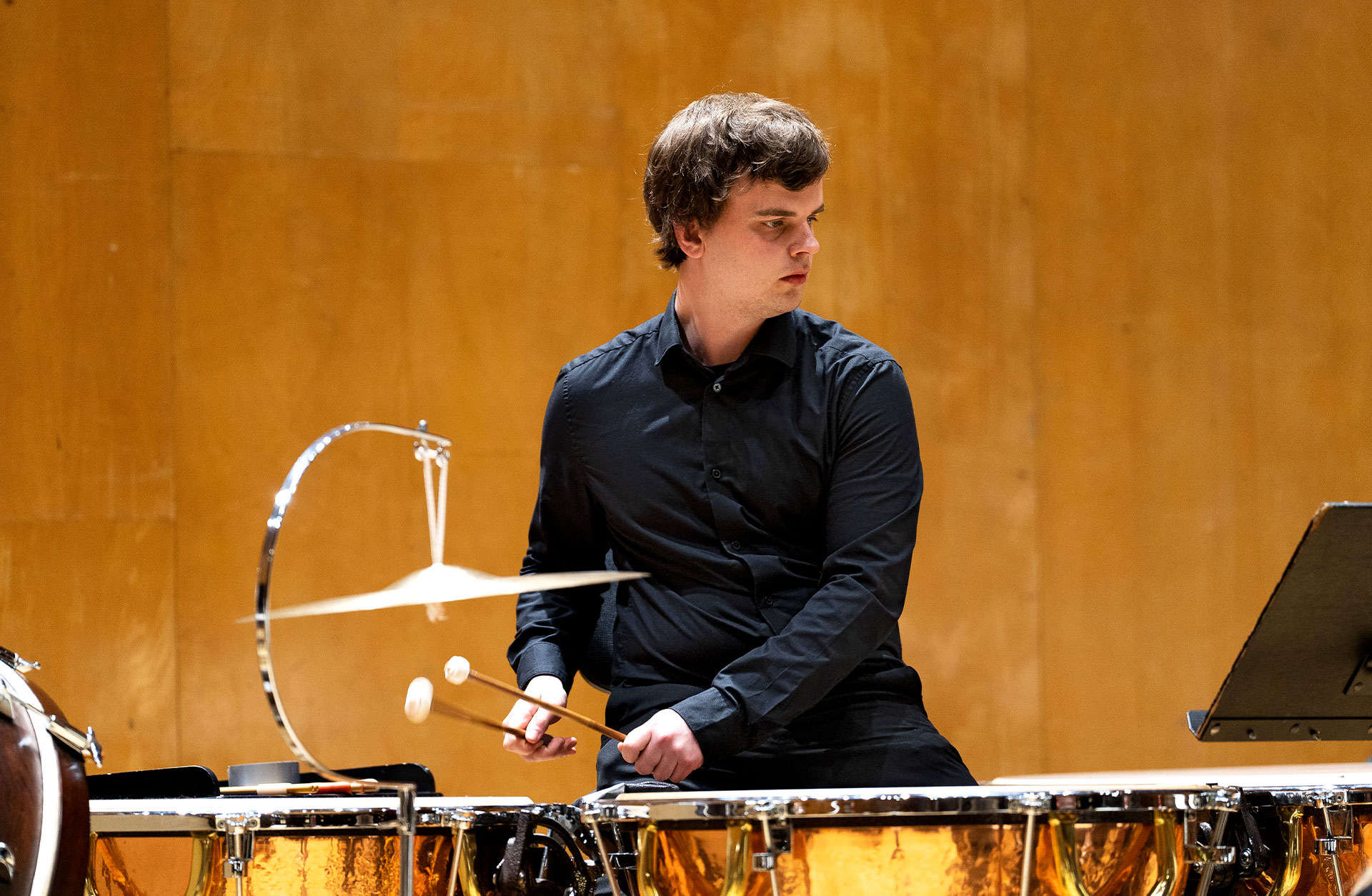
The core of the orchestra is made up of the students of the 2 year international master's program in symphonic orchestra playing at the University of Gothenburg's School of Theater and Music. The training is unique in its kind and is conducted in collaboration with the Gothenburg Symphony Orchestra and the Gothenburg Opera. The orchestra projects also include students from the bachelor's program in classical music – a 3 year program where the student focuses on chamber music playing and individual development on their instrument. Students from other music colleges are invited to participate in and supplement the orchestra. Each academic year, the University of Gothenburg Symphony Orchestra performs eight orchestral productions. Internationally well-known conductors and soloists are engaged. Recently, Simon Crawford-Phillips, Jurjen Hempel, Vince Mendoza and Daniela Musca have been guests of the orchestra. Among the soloists are pianist Christian Zacharias, cellist Amalie Stalheim and violinist Isabelle van Keulen. The orchestra also collaborates with the opera education at the University of Theater and Music. UGSO is an ambassador for the University of Gothenburg, which supports the concert and tour activities.
Finnish conductor Maria Itkonen has established herself as a versatile conductor, both in opera and orchestral repertoire. Highlights of the past season included debuts at the Teatro de la Maestranza in Seville and the Auditorium-Orchestre National de Lyon, with the Helsingborg Symphony Orchestra and the Ostrobothnian Chamber Orchestra. Itkonen has conducted the Helsinki Philharmonic Orchestra, the Royal Stockholm Philharmonic Orchestra, the Tampere Philharmonic Orchestra, the Malmö Symphony Orchestra and the Turku Philharmonic Orchestra. She made her debut at the Stockholm Folk Opera in 2022 with Norma and has premiered several works by contemporary Finnish composers.
Maria Itkonen studied conducting with Professor Jorma Panula in Finland and at the Royal Academy of Music in Stockholm. Before focusing on conducting, she had a career as concertmaster in leading European orchestras.


 031-726 53 00
 biljett@gso.se