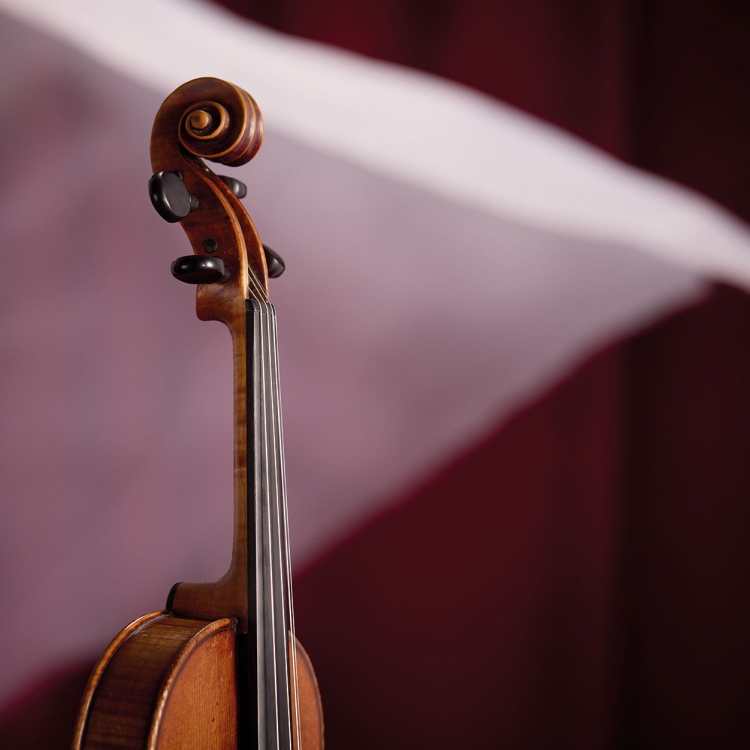
Violinist Nicola Benedetti has been obliged to cancel, and this leads to a change of programme. She is replaced by young Swedish rising star Ava Bahari (born in 1996), who has received numerous Swedish and international awards. Ava Bahari was born in Gothenburg, and she has performed with the Gothenburg Symphony on many previous occasions. She is now based in Berlin, currently completing her advanced studies at the Hochschule für Musik Hanns Eisler Berlin.
Ava Bahari takes on Brahms’ outstanding violin concerto – music with an abundance of melodies and harmonic adventures that lead far beyond the ordinary pathways. The slow movement begins with one of Brahms’ most beautiful melodies – which is presented by the oboe! The euphoric finale offers the occasional nod to friend, inspiration and violinist Joseph Joachim – who performed the world premiere of the concerto – and his Hungarian musical roots, which shimmer here and there in the music.
After the intermission we meet Richard Strauss’ masterful and lavish Ein Heldenleben, a wonderfully self-absorbed heroic tale in which the composer uproariously illustrates friends and enemies, war and peace. But this work also has an element of seriousness in its undertones – Strauss was highly aware of what a phenomenal orchestrator and orchestral magician he was, as he made clear when he gallantly waved his magic wand.
The orchestra is led by the acclaimed Finnish conductor Santtu-Matias Rouvali, Chief Conductor of the Gothenburg Symphony Orchestra.
Programme
Allegro non troppo
Adagio
Allegro giocoso, ma non troppo vivace
At Lake Wörthersee in Austrian Kärnten lies the small idyllic town of Pörtschach. The German composer Johannes Brahms spent the summers of 1877-1879 there. He wandered in the beautiful surroundings and felt so harmonious and happy that the first summer he composed his second symphony in D major and the following summer his violin concerto, also in D major, an unusually positive key for the composer, who was often considered heavy-hearted and worried. The middle of the 1870s and the beginning of the 1880s was the time of the great orchestral works for Brahms, who had previously devoted most of his time to songs, piano, organ pieces and chamber music apart from his great Ein deutsches Requiem from 1868. The second piano concerto, the violin concerto and all four symphonies was created 1876-1885.
One of Brahms' best friends was Joseph Joachim, already a successful solo violinist when they both met in their 20s. It was also Joachim who introduced him to Robert and Clara Schumann in 1853, an important event in Brahms' career and life.
Since he was not very familiar with the violin's technical possibilities, Joachim became his advisor during the composition of the violin concerto. It became a struggle from time to time, Joachim wanted the concert to show his virtuosity in an emotional romantic spirit. Brahms would rather have a dialogue and an equal interplay between orchestra and soloist, demanding for the solo violin, of course, but not a show number of empty display. This does not prevent Brahms' only violin concerto from being a test of strength for the soloist.
At first, the composer wanted a four-movement concerto. But he soon realized that it did not fit into his arrangement of the work. The intended scherzo movement was removed. Brahms is said to have said that there was such an abundance of melodies in Pörtschach that one had to be careful not to step on them! After the orchestra's introduction with powerful rhythmic sections, the soloist gets to begin his interpretation of the energetic music in dialogue with the orchestra. Then everything stops for the soloist's solo cadenza, which at the premiere showed Joachim's fantastic improvisation skills. It was eventually written down and is still often played, although several famous violinists have made their own. At today's concert, however, we get to hear Brahms' approved version of Joachim's cadenza. The second movement is a wonderful, idyllic contrast. It is the oboe that gets to introduce its long beautiful melody before the solo violin takes over for an equally breathless continuation. As a Rococo-inspired depiction of nature in pastoral harmony and sincerity. The third movement has the designation "allegro giocoso" - a playful allegro - but not too fast. Joachim's Hungarian background is celebrated in both the virtuoso solo part and the orchestra's equal expression of joy in the folk dance rhythms of the rondo form and a furiously accelerating ending.
At the premiere in Leipzig on New Year's Day 1879, Johannes Brahms himself was at the conductor's desk. The reviewer Dörffel wrote that "Joachim played with such love and affection that in every measure he could directly or indirectly convey how much he was involved in the work's creation". Today, Johannes Brahms' violin concerto is one of the most played and loved. Time has caught up with both content and technology.
Intermission25 min
The Hero - Adversaries - The Hero's Companions - Battlefields - Deeds of Peace - The Hero's Escape from the World and the Completion of His Life (movements played in sequence)
Strauss had long devoted himself to writing vital orchestral poems that made him Liszt's main successor. But in his music he also developed new ideas, which made him one of the leading modernists of the time. In the symphonic poems he had celebrated heroes: Macbeth, Don Juan, Till Eulenspiegel, Zarathustra, Don Quixote - all literary heroes of superhuman proportions. In order to move on, Strauss needed an even greater hero, drawn not from literature but from real life - and it hardly needs to be pointed out that he faced bitter criticism when it became clear that the hero of Ein Heldenleben was himself. Something that he met with an ironic angle with the statement that he did find himself as interesting as Caesar or Napoleon - or, in other words, that no one is more worthy than another. And by the way, this was no worse than Berlioz writing his Symphonie fantastique about himself.
Strauss was 34 years old. He had left the opera in Munich to take over the directorship of the opera Unter den Linden in Berlin. He had married Pauline de Ahna, the opera singer notorious for her temper tantrums, coquetry and devoted love. All of this is carefully accounted for in the music. The first section, The Hero, begins with a jubilant theme in low strings and horns. Strauss's father had for 49 years been a horn player at the court opera in Munich. It has also been noted that the key is E flat major, the same one Beethoven used in his Eroica symphony. In the second episode, the hero's accusers - the critics - are portrayed. They stand there in comic contrast to the hero, fussy and narrow-minded. That the hero's helper is his wife is quite clear. They flirt, play, kiss, cuddle and get angry - and the third part ends with an intense love duet. The battlefield of the hero is indeed a grandiose war music. The critics' themes are in effective counterpoint to his own theme, and he is morally supported by his beloved's theme. Finally, he stands victorious, and what he values in life is the work for peace - that is, his own compositions. A theme of peace is interwoven with fragments from his other heroic poems already mentioned, as well as from two works connected with Pauline: the opera Guntram and the song Traum im Zwielicht.
Ein Heldenleben is a long symphonic poem in six consecutive movements for mammoth orchestra, and it ends with the hero retreating and completing his quest. It must be said that despite the self-righteous content, the piece also contains some self-critical details. Here there is no pompous heroic apotheosis at the end. On the contrary, it all ends with resignation, as a premonition of Vier letzte Lieder. It is also touching that the themes representing himself are not victory marches but lyrical melodies that rather advocate comfort and tranquility as the highest virtues. A secure bourgeois middle-class attitude, in other words. The score is dated Berlin-Charlottenburg 27 December 1898, and the first performance with the composer himself as conductor took place on March 3 the following year.
STIG JACOBSSON
Saturday, 13 May 2023: The event ends at approx. 17.00
Participants
The Gothenburg Symphony, called "one of the world's most formidable orchestras" by the Guardian, has toured the USA, Europe, Japan and the Far East and performed at major music centres and festivals throughout the world. Chief conductor is Santtu-Matias Rouvali who started his tenure in 2017. Barbara Hannigan and Christoph Eschenbach are principal guest conductors since 2019.
Already at the orchestra's very first years, the great Swedish composer Wilhelm Stenhammar was appointed principal conductor, contributing strongly to the Nordic profile of the orchestra by inviting his colleagues Carl Nielsen and Jean Sibelius to conduct their own works. Subsequent holders of the post include Sergiu Comissiona, Sixten Ehrling and Charles Dutoit. During Neeme Järvi's tenure (1982-2004), the orchestra became a major international force. In 1997 it was appointed the National Orchestra of Sweden. During his celebrated tenure as music director (2007-2012), Gustavo Dudamel took the Orchestra to major music centres and festivals in Europe, making acclaimed appearances at BBC Proms and Vienna Musikverein.
The list of prominent guest conductors has included Wilhelm Furtwängler, Pierre Monteux, Herbert von Karajan, Myung-Whun Chung, Herbert Blomstedt and Sir Simon Rattle. The orchestra also runs extensive concert projects for children, and regularly releases digital live concerts free on gsoplay.se. The orchestra has been involved in many prestigious recording projects, the latest one the complete Sibelius Symphonies with Santtu-Matias Rouvali for Alpha Classics. Earlier, the orchestra has issued over 100 recordings on BIS, Deutsche Grammophon, Chandos, Farao Classics and several other labels. The Gothenburg Symphony is owned by the Region Västra Götaland.
Since 2017, Santtu-Matias Rouvali has been chief conductor of the Gothenburg Symphony. He also has a successful international conducting career and has been hailed by The Guardian as "the latest great talent in the Finnish conducting tradition that you just have to listen to". Santtu-Matias Rouvali is also chief conductor of the Tampere City Orchestra and the Philharmonia Orchestra in London. He has toured with the Gothenburg Symphony and pianist Hélène Grimaud in Nordic capitals as well as with pianist Alice Sara Ott and percussionist Martin Grubinger in Germany.
Throughout the season 2022-2023, Santtu-Matias Rouvali continues his relationships with top level orchestras across Europe, including Berliner Philharmoniker, Wiener Symphoniker, Royal Concertgebouw Orchestra and Münichner Philharmoniker, as well as returning to the New York Philharmonic for his annual visits. He works with soloists including Víkingur Ólafsson, Nemanja Radulovic, Yuja Wang, Nicola Benedetti, Behzod Abduraimov, Patricia Kopatchinskaja, Alice Sara Ott, Sheku Kanneh-Mason, Vadim Gluzman, Randall Goosby, and Vilde Frang.
The violinist Ava Bahari was born in 1996 in Gothenburg. After studying for seven years with Professor Terje Moe Hansen at the School of Music in Oslo, she continued her violin studies with the former concertmaster of the Gothenburg Symphony, Per Enoksson. She has also taken lessons from leading music educators such as Gidon Kremer, Christian Tetzlaff and Ana Chumachenko and studied at the Hochschule für Musik Hanns Eisler in Berlin.
Ava Bahari's career began at the age of eleven when she won her first competitions. In 2010, she qualified for the prestigious Yehudi Menuhin competition as the only representative from Sweden in the class for young people up to 20 years old. The successes continued when she won the Swedish award Polstjärnepriset in 2012.
In 2015, Ava Bahari was a youth grantee at Stenastiftelsen and was able to start her studies in Berlin.
In 2021 she won 3rd prize in the prestigious international Paganini competition. Ava Bahari has also competed in the prestigious Carl Nielsen International Competition where she made it to the final round in 2022.
In 2013, she appeared in SVT's drama series Molanders, where she played the violinist Yulia.
Ava has also received music and culture scholarships, among others from Sten A Olsson's Foundation for Research and Culture, Royal Society of Science and Knowledge in Gothenburg and the Willinska Foundation.


 031-726 53 00
 biljett@gso.se