Event has already taken place. Calle, Janne and Wille were the composers who created the Nordic sound. The Västra Götalands Youth Symphony Orchestra brings our classical masters to a new generation.
Concert length: 2 h incl. intermission
Stage: Stora salen
Calle, Janne and Wille were the composers who created the Nordic sound. Västra Götaland Youth Symphony Orchestra takes our classical masters to a new generation.
Calle, Janne and Wille – the three gentlemen created immortal music and were all associated with the Gothenburg Concert Hall during their careers. The sounds from Carl Nielsen, Jean Sibelius and Wilhelm Stenhammar strike at the heart of the Nordic folk soul. Hear the young musicians in Västra Götaland Youth Symphony Orchestra take our classical masters further to a new generation. Conductor is Andreas Hanson.
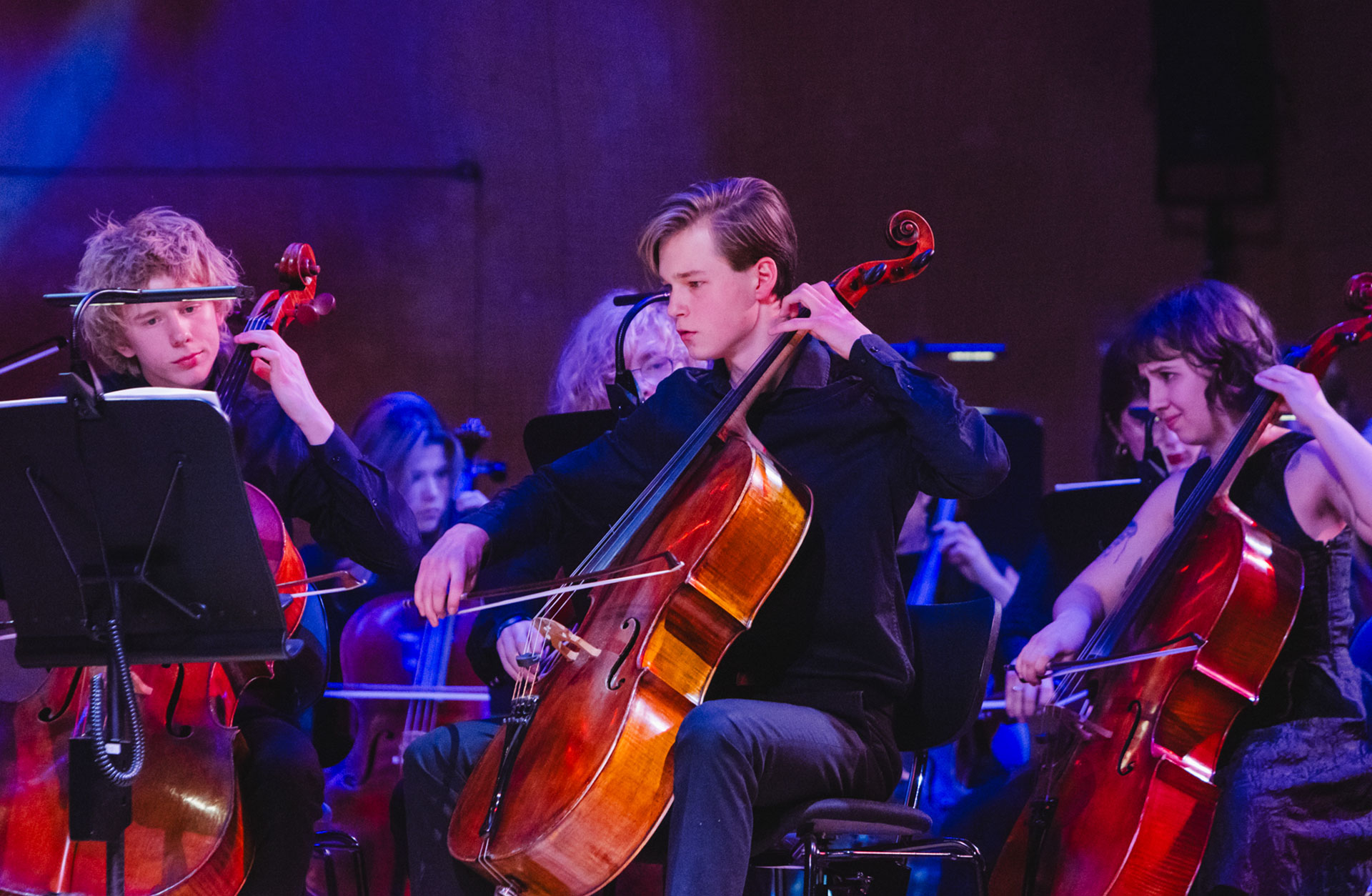
Famous pieces or grand symphonies – in the hands of VÄGUS, everything is performed with the unmistakable desire and energy that has become their special hallmark. The orchestra consists of around 80 young musicians from all over Västra Götaland aged 14-23, and for many, VÄGUS becomes a memory for life.
Highlighting the home region was an expression of Finnish patriotism and the fight for freedom, which was highly relevant in Sibelius' time. One of the more effective artistic expressions of that time was the equivalent of today's art installation: the so-called tableau. Imagine a stage with natural environments, backdrops, props and decorations (scenography, that is) and place real and living people in this room, standing motionless in predetermined poses with convincing expressions.
The Vyborg student department at the University of Helsinki had decided to depict important events in the history of Karelia, and Sibelius was asked to write music for these tableaus. The Karelian city of Vyborg was founded by Swedes at the end of the 13th century and was Finland's second largest city until World War II.
A contemporary description of the three tableaux reads:
Intermezzo: "To the sounds of fanfares and festive processional music, the people of Karelia carry out their tribute to a Lithuanian prince."
Ballad: "Karl Knutsson, overthrown from his throne, listens to a monotonous stylized Finnish song and then dreams himself back to the moods of bygone years, colored by a Scandinavian ballad: the girl in the 'rose haven'."
Alla marcia: "Pontus de la Gardie and his troops march towards Kexholm Castle on the vast Lake Ladoga."
Sibelius originally composed an overture and music for eight tableaux. The overture was published as an independent work, and parts of tableaux nos. 3, 4 and 5 as this Karelia Suite.
Wilhelm Stenhammar was a brilliant pianist who played Beethoven and Mozart's concertos as a soloist, and he toured the whole country with piano recitals or as a chamber musician. He was also one of the foremost Swedish conductors of the time and as such director of the Gothenburg Symphony Orchestra for many years. In addition, he was a romantic composer with a classical and clear musical language. His two symphonies and piano concertos, the serenade for orchestra, choral works, string quartets, songs and piano pieces are among the most beloved Swedish standard repertoire. He was very self-critical, and after listening to his colleague and friend Jean Sibelius's second symphony, he no longer wanted to hear about his own first - and he waited decades before he dared to write his second.
The piece Reverenza has a peculiar background. "I want to write as beautifully about the South as only a Northerner can," Stenhammar wrote in a letter. He wants to write about "flutes and oboes that quintillate like thrushes," about "long, sucking string phrases," about "something at the same time sensual and spiritual, about the strong scent of flowers in pure, sunny air." He was in Florence when he began thinking about Serenade for orchestra in March 1907, which was completed in 1914. A brilliant movement of its own came to live a life of its own under the name Reverenza. It is now often played as a standalone piece, a kind of minuet pastiche, unless one chooses to let it ring in its original place during performances of the Serenade.
Intermission25 min
Carl Nielsen (1865-1931)
Symfoni No. 4 "The Four Temperaments"
When Carl Nielsen in the years 1918-1920 periodically substituted for Wilhelm Stenhammar as conductor of the Gothenburg Symphony, he took the opportunity to perform his second symphony from 1902, called "The Four Temperaments". His impression of the orchestra at this time is touching: "Now I have had a rehearsal with the orchestra and it is a great artistic satisfaction to play with these people, for they follow my slightest cue and show me so much respect that I am almost embarrassed."
So how did the second symphony come about? The composer himself told its story: "I got the idea for the symphony The four temperaments many years ago in a village pub in Zealand, Denmark. When I was drinking a glass of beer with my wife and some friends, I observed a most comical picture hanging on the wall in an old gilt frame.The picture was divided into four fields, in which "temperaments" were presented with titles: the choleric, the phlegmatic, the melancholic, and the sanguine. The choleric sat on a horse. He had a long sword in his hand, with which he slashed wildly into the empty air. The eyes were staring, the hair was fluttering and his face gave an expression of anger and satanic hatred that made me burst out laughing.”
In the second movement, Nielsen describes a young man he met: "I have never seen him dance. He was too inactive for that, but he could swing his body in a slow waltz rhythm." The third movement depicts melancholy and there the musical material seems to have taken its own direction. Carl Nielsen speaks of "a strong outburst... after which the oboe comes with a small melancholy and sighing motif, which gradually develops and reaches a climax of lamentation and pain. "
In the closing movement, a self-righteous type is portrayed: "In the Allegro sanguineo, I have tried to portray the basic character of a man, who storms thoughtlessly forward in the belief that the whole world belongs to him".
The symphony went down well with both audiences and critics on February 18, 1920.
Tuesday, 30 September 2025: The event ends at approx. 21.00
Participants
Västra Götalands Ungdomssymfoniker
Andreas Hanson is leader of the Västra Götalands Youth Symphony from 2025. He studied conducting at the Royal Academy of Music in Stockholm, London and Milan. He is a guest conductor of the major Swedish orchestras and appears as a guest conductor in Europe. He has recorded nearly 20 albums for BIS, Serpent and Chandos. With a strong passion for contemporary music, he has premiered over a hundred contemporary works.
After decades as chief conductor of national wind ensembles, Andreas Hanson has also built up an extensive repertoire knowledge of Nordic musical treasures and symphonic wind music. He has a great commitment to the next generation of musicians and conductors and to the music creation of the future. He is teaching conducting at the Royal Academy of Music and works with Dirigentløftet in Norway.
 031-726 53 00
 biljett@gso.se