Göteborgs Konserthus
The Playful Joy of Stravinsky
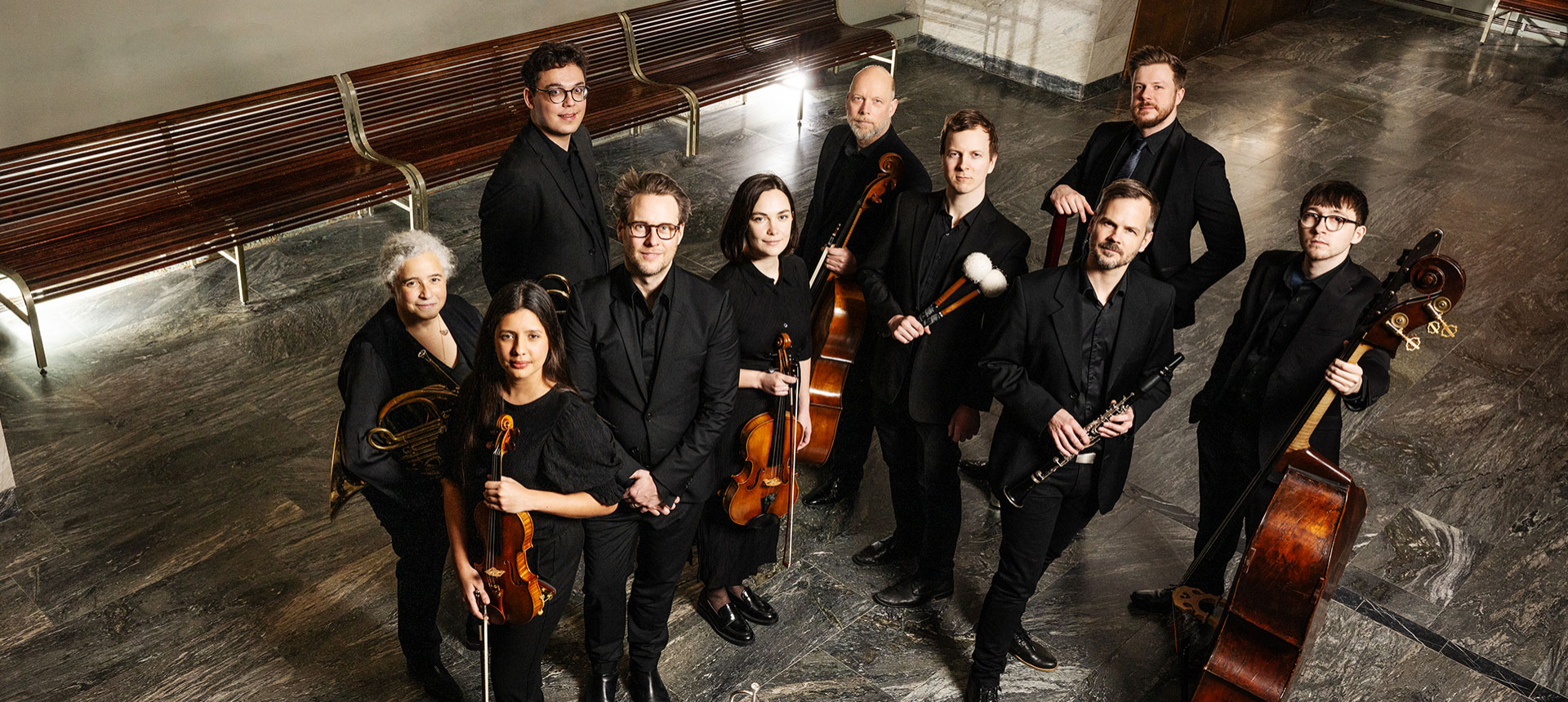
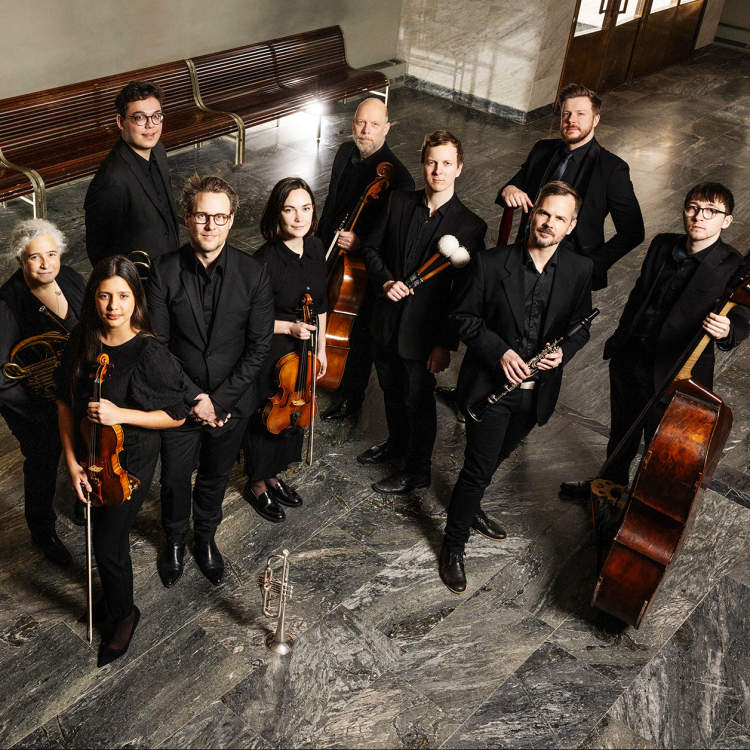
Event has already taken place. A soldier marches away to a princess, the xylophone rings next to the trombone. Lots of humour and adventure as musicians from the Gothenburg Symphony Orchestra play chamber music.
Concert length: 2 h incl. intermission
Stage: Stenhammarsalen
260-330 SEKStudent 130-165 SEK
Young up to 29 130-165 SEK
Enjoy humour and adventure as members of the Gothenburg Symphony Orchestra play chamber music. A soldier marches towards a princess, the xylophone rings out next to the trombone. Music by Stravinsky, Beethoven and Christian Lindberg.
Igor Stravinsky had just fled Russia to settle down beside Lake Geneva. With him, he brought folktales, including one about a soldier who plays cards with the devil. Ragtime was the latest craze on the dancefloor around World War I, and it was everywhere. The young soldier’s walk with a violin in his bag is illustrated through virtuosic playing and strutting rhythms.
Trombone player Christian Lindberg is often considered the best in the world, and his brilliant composition for trombone and percussion exemplifies his humorous music. Gradually, we reach Beethoven’s Septet, which became so popular that the composer was able to live on income from the piece for two years.
A century ago, pianist Teresa Carreño from Venezuela lived an exciting life as an artist and composer, and toured Europe regularly. In 1908, she performed at the Gothenburg Concert Hall on Heden, playing Beethoven’s Emperor Concerto – conducted by Wilhelm Stenhammar himself. Now we hear one of her compositions arranged by the Symphony Orchestra’s violinist Emirzeth Henriquez.
Listen
Get to know the music.
Programme
Christian Lindberg (b 1958)
Trobotubrevalkmah
It was in Milan, at the world premiere of my piece Behac Munroh, that Giuliano Rizotto asked me to write a piece for his duo Vib'Bone. I had been thinking about trombone and percussion for a long time, so it was with pleasure that I accepted his commission, and I was even happier when I heard that it was to be premiered at the prestigious international music festival in Stresa. Giuliano is a dedicated orchestral musician, and as a solo trombonist he has become an expert on all solos written for the trombone. As a tribute to him, and to other orchestral trombonists, I have built this piece on tonal material from some of these solos. However, my intention is not to make the audience try to figure out who they are; if you don't recognize them, it's not because you don't have a musical ear ... The themes are transformed into a new context, sometimes inverted.
Ever since I became a Beatles fan at the age of six, I have developed an enthusiasm for certain percussion instruments. In this piece, I've incorporated five of my favorite sounds: wooden blocks, tambourines, bass drum, glockenspiel, and vibraphone.
Christian Lindberg
Igor Stravinsky (1882-1971)
Suite - The Soldier's Tale
The Soldier's March - Airs by a Stream - Pastorale - Royal March - The Little Concert - Three Dances - Dance of the Devil - Grand Choral - Triumphal March of the Devil
The year was 1917, World War I was raging in Europe. Neutral Switzerland had become a refuge for artists of various trades. Among them was the Russian-born composer Igor Stravinsky. One of his friends has described the creation of The Soldier's Tale: "Together with fellow artists who were in the same difficulty - the writer Charles-Ferdinand Ramuz, the conductor Ernest Ansermet and the painter Auberjournais - he came up with an original plan to make money: they would start a theater tour with a play with as few people as possible participating /.../ The subject was taken from a collection of Russian fairy tales which contained a series of stories about deserting soldiers, a story about a Russian sense but with a general human content." The story also came to symbolize the man who has lost his soul, a man who finds it difficult to find his way in a divided and torn post-war world.
The small size of the orchestra forced Stravinsky to choose high and low instruments within each instrument group to achieve the greatest possible contrast. There was a violin and a double bass, a cornet and a trombone, a clarinet and a bassoon and percussion. The music has a strong rhythmic character, there are march-like tones to musically illustrate the soldier returning home. In a dance scene at the end of the melodrama, Stravinsky mixes modern dance rhythms of the time: tango, waltz and ragtime.
The work was first performed in Lausanne on 28 September 1918 and has since been performed regularly around the world, both staged and in concert form.
Intermission25 min
Teresa Carreno (1853-1917)
Intermezzo scherzoso (arr Henriquez)
Teresa Carreño was a Venezuelan pianist, mezzo-soprano and composer. She was considered a child prodigy from her early piano days. She improvised, composed and performed regularly at prestigious events and played for personalities such as Abraham Lincoln. Carreño lived in North America, France and Germany, where she developed a successful career as a soloist and became internationally recognized as the "Valkyrie of the Piano" due to her distinctive strength and energy. Carreño lived during a time when what was known as salon music was mostly popular music filled with fireworks and virtuosity.Most of her works fall into this category, but she also incorporated folk themes from Latin America and Europe.The majority of her compositions were written for piano, with the exception of a few pieces for choir, a string quartet and a serenade for strings.
Emirzeth Henriquez
Ludwig van Beethoven (1770-1827)
Septet in E-flat
Beethoven's septet from the year 1800 became something of a watershed in his output. Before that, he still studied with Mozart and Haydn. Now he could proudly declare: The Septet is my 'Creation' (of course referring to Haydn's masterpiece). Afterwards, the piece came to represent "the good old days" for an audience that could not digest his late piano sonatas and string quartets. Something that annoyed Beethoven: for him the Septet was after all a work of youth. The contemporary status of the piece is shown by the fact that the script was sold at auction after Beethoven's death for 18 florins, while the manuscript of the huge Missa Solemnis fetched only 7!
In a slow prelude, violin and clarinet engage the listener before the swirling rich allegro (indeed con brio; fiery) breaks loose. In the second movement, the clarinet takes up both main themes, which are spun on by the violin and bassoon, respectively. Both opening movements are written in classical sonata form. He has used the theme of the elegant minuet before; in the clarinet trio Op 11 and the piano sonata Op 49, but never with such humor and maturity as in the septet. In the trio, the horn and clarinet get to perform with an elegance that already hints at the completion of the eighth symphony. The fourth movement takes up a folk song-like theme in five variations and coda. The scherzo offers a cello solo in the waltz-like trio, and the finale fades into a slow march before the virtuoso arts are brought out again.
Sunday, 23 March 2025: The event ends at approx. 20.00
Participants
Musiker ur Göteborgs Symfoniker
Emirzeth Henríquez
Manon Briau
Johan Stern
Marcus Elliott Gaved
Ragnar Arnberg
Clara Manaud
Since 1993, Lisa Ford has been the principal horn player in the Gothenburg Symphony Orchestra. Lisa is an active chamber musician and soloist and a member of the Contemporary Music Ensemble Gageego. She is a senior lecturer at the Academy of Music and Drama at the University of Gothenburg and serves as a mentor for the Master’s Program in Symphonic Orchestral Performance, where she coaches brass and chamber music ensembles. Lisa was educated at Interlochen Arts Academy, graduated from the Norwegian Academy of Music, and has been a member of the Civic Orchestra of Chicago. She previously served as Assistant Principal Horn of the San Diego Symphony Orchestra. Lisa holds a degree in Catalytic Coaching and is a certified professional coach.
The trumpeter Per Ivarsson has been principal trumpet in the Gothenburg Symphony Orchestra since 2011. He was recruited to the Malmö Symphony Orchestra even before he graduated from the Academy of Music in Karlsruhe, where he studied for six years. Per Ivarsson was born and raised in Malmö and started playing the trumpet when he was six years old. He has studied with Björn Lovén, Reinhold Friedrich and Håkan Hardenberger. Per Ivarsson is also a devoted chamber musician. With the Gothenburg Symphony Orchestra, Per Ivarsson has, among many other things, been a soloist in Jolivet's Heptade for trumpet and percussion and in Jolivet's second trumpet concerto. He has also made several recordings for GSOplay.
Arno Tri Pramudia
Walter Witick was employed by the Gothenburg Symphony in 2023. He was born in 1992 in Karleby, Finland and began his studies as an 8-year-old at the Middle Österbotten Conservatory. In 2007, he began his studies at the Sibelius Academy's youth department and went on to obtain a bachelor's degree at the Amsterdam Conservatory and a master's degree from the Sibelius Academy. Alongside his work in the orchestra, chamber music is close to his heart.

 031-726 53 00
 biljett@gso.se