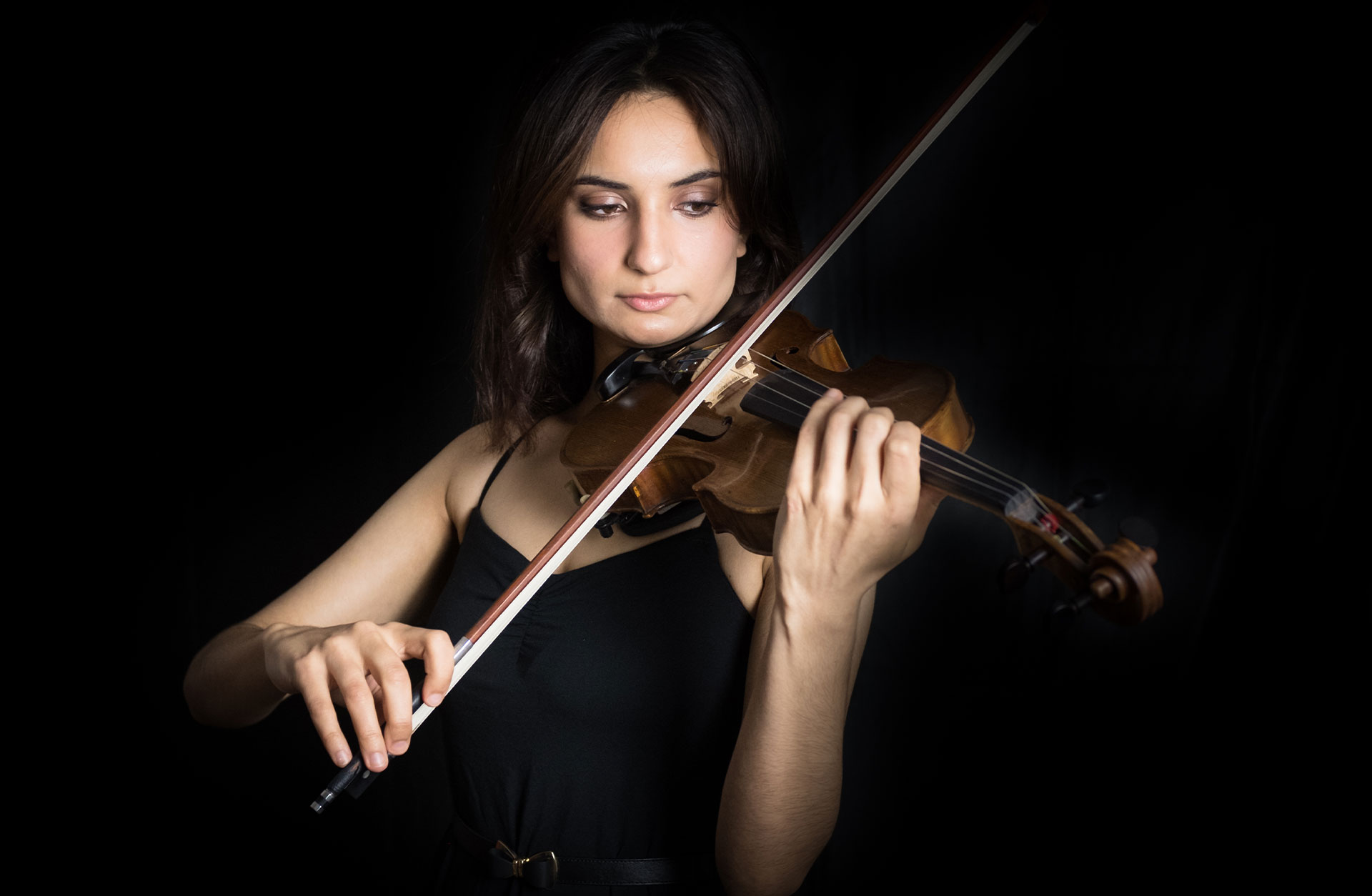
It is said that César Franck’s Piano Quintet in F minor leaves no one unmoved. Seize this chance to hear Artist in Residence Ava Bahari in a spectacular ensemble performance with musicians from the Gothenburg Symphony Orchestra.
Comments heard of César Franck’s piano quintet: Explosive. Hotly emotional. His best work. But also: sugary sweet and wonderfully self-absorbed.
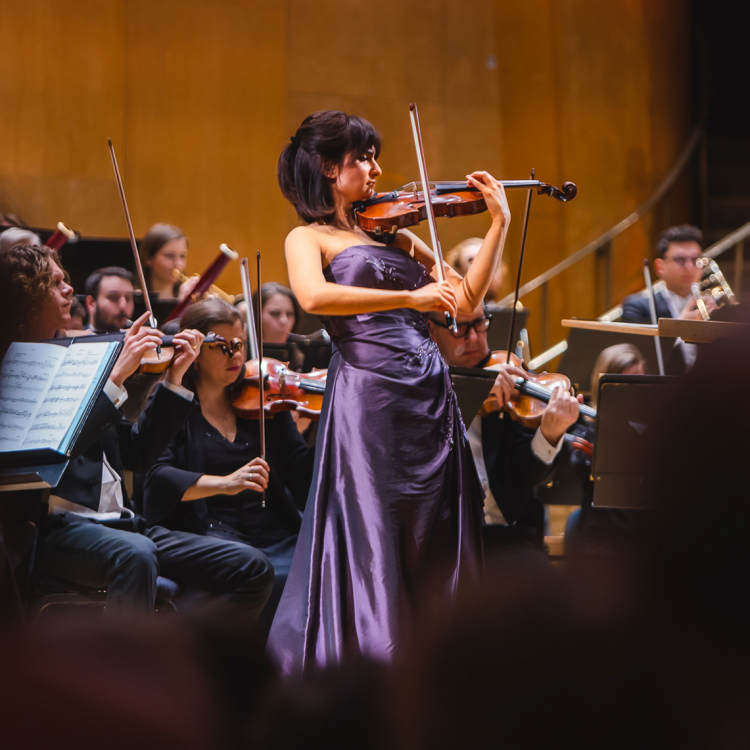
This is your chance to see what you think for yourself as our Artist in Residence, violinist Ava Bahari, gives a chamber concert performance with musicians from the Gothenburg Symphony Orchestra.
At the world premiere in Paris of Franck’s piano quintet in 1880, pianist Camille Saint-Saëns caused a minor scandal. After the final chord, he left the sheet music where it was, stood up and left, without receiving the audience’s applause. He must not have been very impressed by the music, and bear in mind, it was dedicated to him: Franck attached a note to the music that said “my good friend”.
The evening is finished off with Shostakovich’s Symphony No. 15 arranged for chamber ensemble. It contains a catalogue of everything the Russian master had to offer, with bold ideas and unexpected allusions to his own and others’ famous works.
Listen
Get to know the music.
Programme
César Franck (1822-1890)
Piano Quintet F minor
When Belgian-French César Franck wrote his piano quintet, he was a relatively unknown composer, but the work instantly made him famous in the music world. In the 19th century, this music was interpreted as an undisguised display of sexual desire. Both Liszt and Saint-Saëns are said to have been shocked, and the wife is said to have accused Franck of infidelity. It is true that at this time Franck had a favorite pupil, the later famous composer Augusta Holmès (1847-1903), who was 25 years his junior. Possibly he may have been in love with the colorful woman.
Saint-Saën's disapproval, despite having the work dedicated to him, may have been due, according to malicious claims, to his own crush on Holmès. Completely independent of this gossip, it is a question of fantastic music, perhaps one of the most passionate chamber works of the 19th century.
The first movement begins with a slow and long introduction, Molto moderato, with a dramatic theme in the strings and another in the piano. Both of these themes are repeated and varied. The second movement is very melancholy and provides an opportunity for recovery, and then leads to a closing movement where the main theme reappears.
Intermission25 min
Dimitri Sjostakovitj (1906-1975)
Symphony No 15 Op 141, arr Derevianko
Shostakovich's last symphony is one of his rare orchestral works from his last years. It was first performed by his son Maxim Shostakovich in January 1972 and is a unique work in many respects. It was then almost 50 years since he began his first, ingenious symphony. But in many ways the two symphonies are close to each other: the virtuosic orchestral treatment, the escape, the boldness of the ideas, the unexpected associations with allusions to their own and others' works.
Most surprising is probably the clear quote from Rossini's Wilhelm Tell overture that appears in the first movement. Incidentally, there is also a twelve-tone series - yes, it recurs in all the movements. The second movement is a mourning march-like lament that contrasts with the scherzo. The predominantly slow finale offers several famous quotations, including the death motif from the second act of Wagner's Valkyrie. In the drums you hear rhythms from his own Leningrad Symphony.
The composer has made the following statement: "It is a great shame that the composers seem to be bypassing Chekhov. One of my works is based on motifs by Chekhov, the Fifteenth Symphony. It is not a prelude to The Black Monk, but variations on a theme. Much in the fifteenth is related to The Black Monk, although it is a completely independent piece."
The Black Monk is a short story by Chekhov that Shostakovich had long-standing plans to write an opera about - in the end the plans resulted in this symphony instead.
Viktor Derevianko wrote a chamber version of the symphony in 1972 with the approval of the composer.
Sunday, 19 January 2025: The event ends at approx. 20.00
Participants
Musiker ur Göteborgs Symfoniker
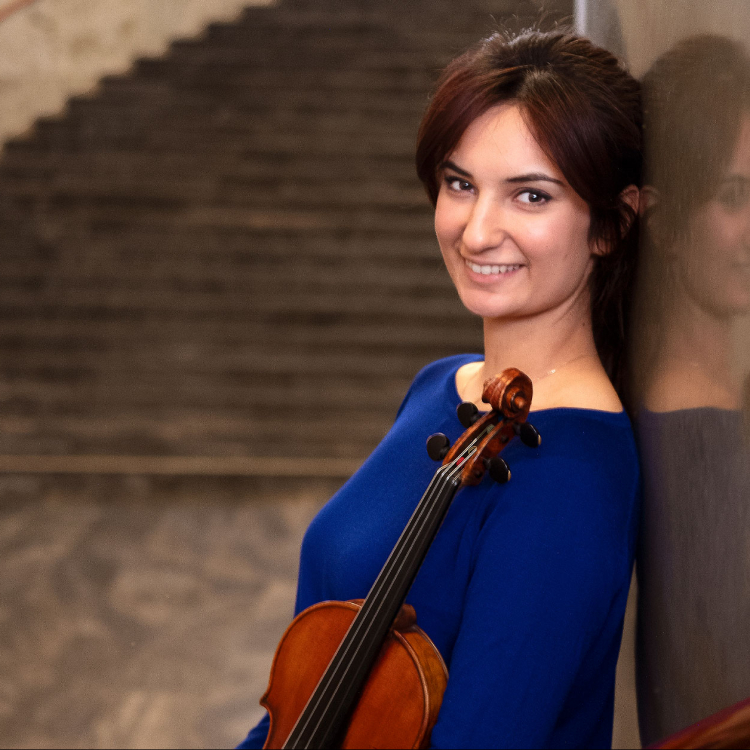
The violinist Ava Bahari was born in 1996 in Gothenburg. She began playing the violin at the age of three and gave her first solo concert at age eight in the Gothenburg Concert Hall. She studied at the Oslo Music Academy's Young Artist Program under the tutelage of Prof. Terje Moe Hansen. From 2011 to 2015, she continued her studies with Prof. Per Enoksson in Gothenburg Symphony.
In 2015, Ava Bahari began her Bachelor and Master studies at the Hochschule für Musik Hanns Eisler Berlin under the guidance of Prof. Kolja Blacher and received her Diploma in May 2024. In 2021, she also completed a degree at the Accademia Stauffer in Cremona, Italy. Ava Bahari has received numerous awards including 3rd Prize at the Premio Paganini Competition in Genova, 4th Prize at the Concours International Tibor Varga in Sion in 2021, and 1st Prize at the Aurora Music Competition in Stockholm in 2019.
Throughout her career, Bahari has had the privilege of being mentored by some of the world's most renowned violinists and pedagogues including Leonidas Kavakos, Mihaela Martin, Pierre Amoyal, Midori Goto and Boris Kuschnir.
Bahari has worked with conductors such as Santtu-Matias Rouvali, Pekka Kuusisto and Ryan Bancroft and performed with esteemed orchestras such as the Royal Stockholm Philharmonic Orchestra, Gothenburg Symphony Orchestra, Teatro Carlo Felice Genova, Baden-Baden Philharmonie, Malmö Symphony Orchestra, Odense Symphony Orchestra and Gävle Symphony Orchestra. Upcoming orchestral debut in the next season includes concerts with The Philharmonia Orchestra, Tokyo Symphony Orchestra, Helsinki Philharmonic and BBC National Orchestra of Wales.
Some of her more notable recital performances include a Paganini recital at the Seoul Arts Center, a recital on the "Stauffer" Guarneri del Gesù 1734 in museo del Violino Cremona and a recital in Konzerthaus Berlin.
Ava Bahari has also received music and culture scholarships from Sten A Olsson's Foundation for Research and Culture, Royal Society of Science and Knowledge in Gothenburg and the Willinska Foundation.
With the Gothenburg Symphony, she made her soloist debut in January 2023 in Schönberg's violin concerto.
Andrei Banciu is an active chamber musician with involvement throughout Europe. He founded the Jacques Thimbaud Ensemble and has been involved in several chamber music festivals in Belgium, among others. Since 2012 he has been teaching at the Music Academy in Leipzig and since 2018 at the Hanns Eisler School in Berlin. Banciu was born in Romania and in his younger years was a prizewinner in a number of soloist competitions.
Violinist Marja Inkinen Engström has a diploma in violin playing from the Sibelius Academy (Master of music for professor Tuomas Haapanen) and from the Utrecht Conservatory in Holland. Sandor Vegh, Chaim Taub and MiKyung Lee have meant a lot to her musical development. Since 1998, Marja Inkinen Engström has been principal for second violins in the Gothenburg Symphony Orchestra. She often appears as a chamber musician and soloist.
At the Gothenburg Concert Hall, she has collaborated in chamber music contexts and as a soloist with musicians such as cellists Lynn Harrell and Daniel Müller-Schott, pianist Christian Zacharias and viola player Brett Dean, as well as colleagues in the orchestra. Since 2002, she has been teaching violin, orchestral playing and chamber music at the University of Stage and Music in Gothenburg as well as at other institutions. Marja Inkinen Engström plays on a Francesco Ruggieri from 1680 owned by the Gothenburg Symphony.
Tuula Fleivik is co-principal for the violas in the Gothenburg Symphony Orchestra. She studied violin at the Helsinki Conservatory and viola at the Sibelius Academy and the Guildhall School of Music and Drama. In 2000-2001 she was a member of the Verbier Festival Youth Orchestra. She has worked as principal in Sinfonia Lahti, Oulu Symphony Orchestra, Orquestra de la Comunitat Valenciana (Palau de les Arts) and Helsinki City Orchestra. Tuula Fleivik also has a great interest in contemporary music and has played with ensembles such as Gageego! and the Zagros Ensemble.
Cellist Claes Gunnarsson has toured all over the world as a soloist, chamber musician, orchestral musician and teacher. He debuted at a young age as a soloist in Dvorak's Cello Concerto together with the Gothenburg Symphony and was subsequently invited as a solo cellist. A position he has held since 1998.
As an active chamber musician, Claes Gunnarsson has collaborated with the violinists Leonidas Kavakos and Nikolaj Znaider, the pianists Christian Zacharias, Peter Jablonski and Hélèn Grimaud, but aboe all has given concerts for 20 years together with his colleagues Sara Trobäck and Per Lundberg in the piano trio Trio Poseidon..
Claes Gunnarsson is also a teacher at the University of Gothenburg's School of Theater and Music. He plays a cello built in 1707 by David Tecchler, a generous loan from the Järnåker Foundation.
Walter Witick was employed by the Gothenburg Symphony in 2023. He was born in 1992 in Karleby, Finland and began his studies as an 8-year-old at the Middle Österbotten Conservatory. In 2007, he began his studies at the Sibelius Academy's youth department and went on to obtain a bachelor's degree at the Amsterdam Conservatory and a master's degree from the Sibelius Academy. Alongside his work in the orchestra, chamber music is close to his heart.
Fredrik Björlin percussion
Hans Hernqvist has been percussionist in the Gothenburg Symphony since 1991 and has participated in most productions and recordings as well as in chamber music contexts. After studying at the Malmö Academy of Music and at the Royal Academy of Music in Stockholm, Hans worked as an orchestral musician and was employed as a percussionist in the Royal Stockholm Philharmonic before moving to the Gothenburg Symphony.
Hans also teaches percussion and orchestral playing at the University of Gothenburg's School of Theater and Music.
 031-726 53 00
 biljett@gso.se