Join a soiree with the Gothenburg Symphony’s First guest conductor Barbara Hannigan. A beautiful Sunday evening filled with challenging and emotionally charged music, from Hindemith and Schönberg to the Grammy-awarded contemporary composer Caroline Shaw.
Caroline Shaw is the 40-year-old young American composer who both hip-hop artists and film directors want to work with. There have been no fewer than three Grammys, and in 2022 she received the award for contemporary classical composition of the year (for Narrow Sea). Her piece Entr’acte for string quartet has become widely circulated and is said to be inspired by Haydn.
Barbara Hannigan often follows a common thread in her concerts. Tonight we meet courageous music that has broken free from conventions and oppression. Paul Hindemith was the composer who was forced to go out in World War II and then devoted his life to a dogged pursuit of artistic freedom. Just like Arnold Schönberg, he refused to follow given norms and found his own expression. Both jazz tones and atonal experiments that leave an unforgettable impression are hidden here.
Listen
Get to know Barbara Hannigan.
Programme
Richard Strauss (1864-1949)
Sextet from Capriccio
Richard Strauss wrote his last opera in 1940-41 in the middle of a raging war. Capriccio is an opera about opera, a conversation piece, which lacks both Salome's drama and the wonderful arias of Die Rosenkavalier. This may have contributed to it not becoming as popular as many of Strauss's other works in the genre.
The libretto was written by his friend Clemens Krauss but the idea originally came from the writer Stefan Zweig. Perhaps he wanted to write an opera with a content that defied the barbarism going on around him. If civilized persons could converse, why not also countries? And it must have been provocative for those in power that the opera discusses the quality of the music of Couperin and Rameau, composers whose music was hardly ever performed on the concert stages of the Third Reich.
The action takes place around 1775 at a castle in the vicinity of Paris. A party has gathered to celebrate Countess Madeleine's birthday. As a recent widow, she is wooed by the composer Flamand and the poet Olivier. She is torn about which of them to choose. The two get to embody the question of which art form comes first, music or literature, a question that can also be said to be the theme of the opera. It will receive no response. How could an opera composer do otherwise than leave the question unanswered?
The sextet, which functions as an overture, is composed in the opera by Flamand as a gift of love to the countess. However, the style of the work is neither rococo nor modernism. Here, instead, there is much of the mood that characterizes Strauss's own late romantic style before the turn of the century. With the counterpoint of the parts and many dialogues, it is a genuine piece of chamber music in its own right. The 1-movement sextet has a clear three-part form, broadly similar to sonata form. A short exposition with a very pregnant side theme is followed by a very long middle part with a carry-through character. In the concluding part, the main group and side group return, both in the tonic. In the main group there is no meaningful theme, but rather a number of shorter phrases/motifs that stand out.
Swedish Chamber Music Association; Yngve Bernhardsson
Paul Hindemith (1895-1963)
Des Todes Tod
Face of Death and Misery
God's Death
Death's death
Through his lifelong work with literature, Hindemith drew musical inspiration from a variety of poets and schools of poetry: from the great expressionists such as Trakl and Kokoschka as well as from the classics, from pioneers of modernism such as Whitman as well as from contemporary artists. One of his more difficult literary relationships was the collaboration with the young Eduard Reinacher, whom he met in 1921 before the premiere of his three early one-act operas in Stuttgart. While Reinacher hoped for a collaboration, Hindemith initially found no musical input to the poems: “If I am going to turn a poem into a song, it must have loose passages that are left out, as it were, by the poet, left free for the composer, in such a way that the music is needed here. But you work in your own way as a musician; there is no room for me to contribute my own…”
In this setting of three poems from Reinacher's Dance of Death cycle, which Hindemith did in early January 1922, he created “loose passages” himself, giving ample space to two violas and two cellos between the declamations of the vocal voice. Not the least of these - the alternation between the instruments' post-Wagnerian, rich emotional aura, reminiscent of Schönberg's Verklärte Nacht, and a vocal voice carried in a kind of plaintive tone, as in 17th-century psalm singing - from which the bicycle derives its fascination.
Intermission25 min
CAROLINE SHAW (b 1982)
ENTR'ACTE
Caroline Shaw was the youngest composer ever to be awarded the Pulitzer Prize for music when she received the prize at the age of 30 for the choral song Partita. She is also a trained violinist, chamber musician and singer, mostly in the group Roomful of Teeth. She has since received commissions from Carnegie Hall, the Guggenheim Museum, St Paul's Chamber Orchestra and our own mezzo-soprano Anne Sofie von Otter. The Attacca Quartet won a 2020 Grammy for Best Chamber Music Album for their recording of Shaw's music, including the piece Entr'acte.
Shaw wrote her chamber orchestra composition Entr'acte in 2011 after hearing a performance of Joseph Haydn's String Quartet op 77:2 that moved her deeply, not least the soulful switch to D flat major in the minuet's trio movement. She therefore let her own work follow the same structure as a classical minuet in three sections that show completely different sides. "Like suddenly seeing the other side of Alice's glasses" in Wonderland. Like some kind of absurd, fine-tuned, technicolor transformation. Here and there you get delicate moments of music from the classical era and the baroque, which have just discovered they are in the wrong century.
Stig Jacobsson
Arnold Schoenberg (1874-1951)
String Quartet No. 2 in F minor Op 10
Moderate
Very fast
Litany: Slow
Entrückung: Very slow
This quartet is interesting in several ways. Partly, the last two movements have been supplemented with a soprano part, partly the first three movements are tonal, while the last has no tonal anchoring at all. It can therefore be said to summarize the 20th century's transition from tonal to non-tonal music in a single work. But the last three movements were also written during a time of crisis for the composer. The marriage had begun to crack and Schönberg's wife Mathilde Zemlinsky disappeared during the summer of 1908 from her husband and two small children. It is not difficult to imagine that the text of the soprano part in movement 3, which is a prayer for liberation from love and desire, is a reflection of Schönberg's own feelings at this time and the quartet has the dedication Meiner Frau (To my wife).
The first movement, Mässig, is written in conventional sonata form. After a number of listens, you start to recognize the different themes that are used and combined in a masterful way. The execution begins in piano with theme 1, played ponticello, which creates a glassy sound.
The second movement is a fast scherzo, Sehr rasch. To the first violin's scherzo theme No. 3, violin 2 plays the Viennese percussion "O, du lieber Augustin, alles ist hin!" (Alas, you dear Augustin, all is lost). This element has been interpreted as a farewell to the tonal music, but can of course also be a suitable self-deprecating comment on the ruined marriage.
For the first time in music history, the almost inviolable composition of the string quartet is complemented by a soprano part. This alone was enough to upset fundamentalist music believers. The movement is called Litanei, which is also the name of the poem by Stefan George, which the soprano part interprets.
The last movement has sonata form and the musical structure is more parallel to that of the poem. First, a slow instrumental introduction is heard. Schönberg himself has described this as a journey from Earth to another planet. In it he has tried to reproduce the liberation from gravity and how the passage through the clouds in increasingly thin air erases all the sorrows of earthly life from the memory. The main theme, which then follows and is presented in the soprano voice, has the lyrics: I breathe air from other planets.
Swedish Chamber Association, Yngve Bernhardsson (excerpt)
Sunday, 10 March 2024: The event ends at approx. 20.00
Participants
Musiker ur Göteborgs Symfoniker
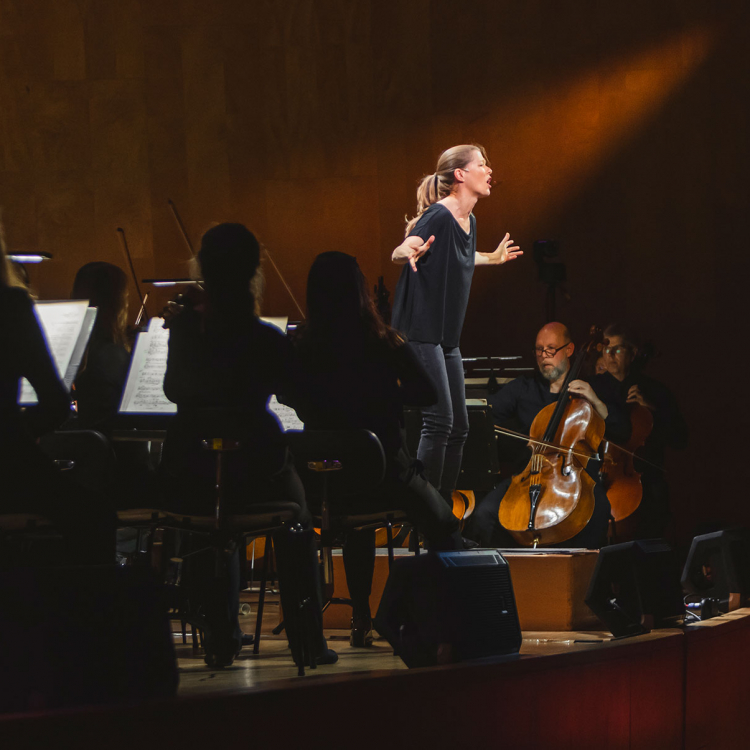
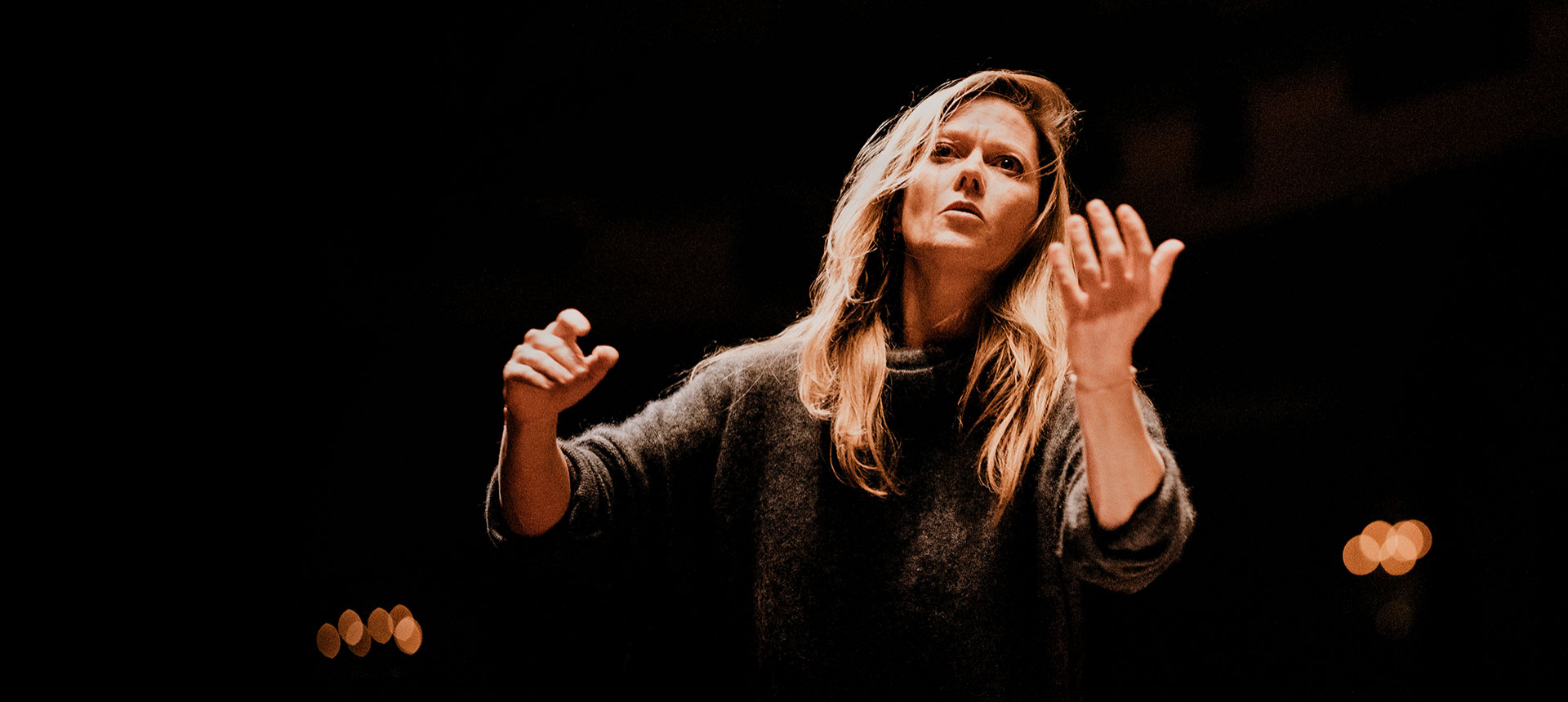
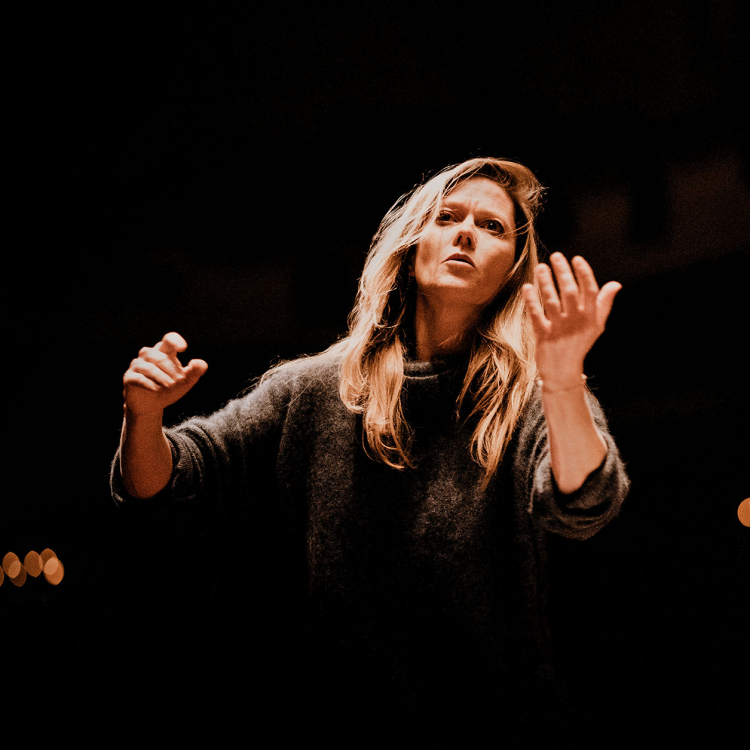
Soprano and conductor Barbara Hannigan is Principal Guest Conductor of the Gothenburg Symphony since 2019. She is also Première Artiste Invitée of Orchestre Philharmonique de Radio France, Associate Artist of London Symphony Orchestra and Principal Guest Conductor of Lausanne Chamber Orchestra (2024/25 onwards).
Embodying music with an unparalleled dramatic sensibility, soprano and conductor Barbara Hannigan is an artist at the forefront of creation. Her artistic colleagues include John Zorn, Krszysztof Warlikowski, Simon Rattle, Sasha Waltz, Kent Nagano, Vladimir Jurowski, Andreas Kriegenburg, Andris Nelsons, Esa Pekka Salonen, Christoph Marthaler, Antonio Pappano, Katie Mitchell, and Kirill Petrenko. The late conductor and pianist Reinbert de Leeuw has been an extraordinary influence and inspiration on her development as a musician. The Canadian musician has shown a profound commitment to the music of our time and has given the world première performances of over 90 new creations. Hannigan has collaborated extensively with composers including Boulez, Zorn, Dutilleux, Ligeti, Stockhausen, Sciarrino, Barry, Dusapin, Dean, Benjamin and Abrahamsen.
The past few seasons have brought the premiere of a new production of Poulenc's opera La Voix Humaine, and recent world premieres include Golfam Khayam's I am not a tale to be told with Iceland Symphony Orchestra, John Zorn's Split the Lark and Star Catcher, Zosha di Castri's In the Half Light with the Toronto Symphony Orchestra, and a new project with Katia and Marielle Labeque inspired by the life and music of Hildegard von Bingen.
2023-2024 includes further world premieres by John Zorn, Salvatore Sciarrino, and Jan Sandström. Last season, Barbara made her conducting debut with the Royal Concertgebouw Orchestra, with further debuts with Montreal Symphony Orchestra and Orchestre de Chambre de Lausanne, as well as ongoing musical collaborations with Orchestre Philharmonique de Radio France, LSO, Santa Cecilia, Danish Radio Symphony Orchestra and Munich Philharmonic.
On record, Barbara Hannigan’s fruitful relationship with Alpha Classics began in 2017 with the release of Crazy Girl Crazy, which won the 2018 Grammy Award for Best Classical Solo Vocal album. Five critically-acclaimed recordings followed, including Vienna: fin de siècle with pianist Reinbert de Leeuw, La Passione featuring works by Nono, Haydn and Grisey, and in 2023 Infinite Voyage, joining her colleagues of the Emerson String Quartet for their final album, in works of Schoenberg, Hindemith, Berg and Chausson. Spring 2024 brings the release of the ecstatic vocal works of Messiaen with pianist Bertrand Chamayou.
Barbara’s commitment to the younger generation of musicians led her to create the mentoring initiatives Equilibrium Young Artists (2017), and Momentum: our Future Now (2020). In 2021, Barbara Hannigan was appointed an honorary scholarship holder by the Swedish Stenastiftelsen and received a scholarship amounting to SEK 300,000. In 2022, she was named Artist of the Year by Gramophone magazine.
Barbara Hannigan resides in Finistère, on the northwest coast of France, directly across the Atlantic from where she grew up in Waverley, Nova Scotia, Canada.
Justyna Jara violin
Terje Skomedal violin
Per Högberg viola
Tuula Fleivik Nurmo viola
Cellist Claes Gunnarsson has toured all over the world as a soloist, chamber musician, orchestral musician and teacher. He debuted at a young age as a soloist in Dvorak's Cello Concerto together with the Gothenburg Symphony and was subsequently invited as a solo cellist. A position he has held since 1998.
As an active chamber musician, Claes Gunnarsson has collaborated with the violinists Leonidas Kavakos and Nikolaj Znaider, the pianists Christian Zacharias, Peter Jablonski and Hélèn Grimaud, but above all has given concerts for 20 years together with his colleagues Sara Trobäck and Per Lundberg in the piano trio Trio Poseidon.
Claes Gunnarsson is also a teacher at the College of Stage and Music at the University of Gothenburg. He plays a cello built in 1707 by David Tecchler, a generous loan from the Järnåker Foundation.
 031-726 53 00
 biljett@gso.se