Sthlms konserthus
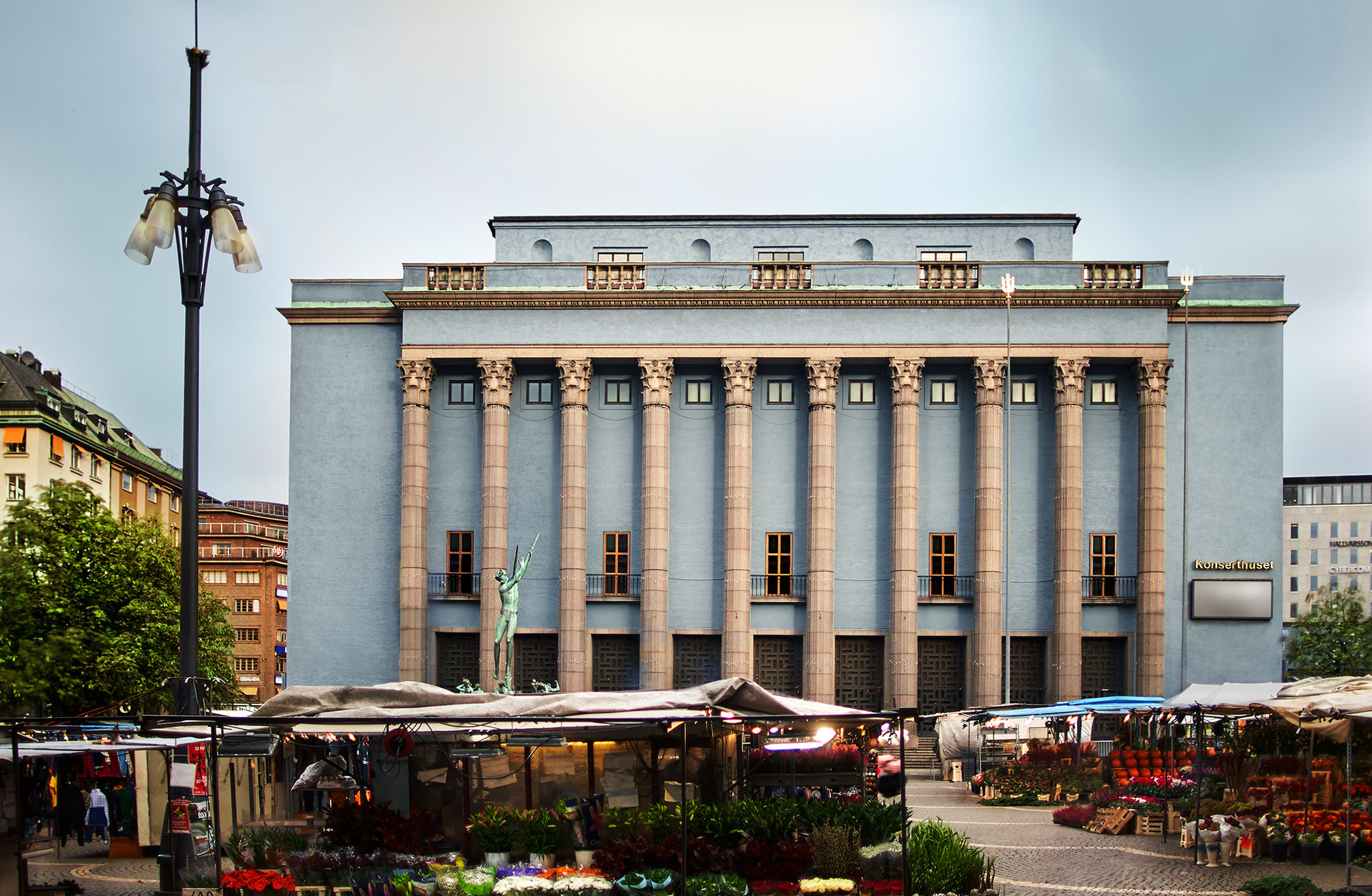
Gothenburg Symphony plays in Stockholm
Event has already taken place. Gothenburg Symphony Orchestra plays in the Stockholm Concert Hall together with chief conductor Santtu-Matias Rouvali and pianist Bruce Liu.
Gothenburg Symphony Orchestra plays in the Stockholm Concert Hall together with chief conductor Santtu-Matias Rouvali and pianist Bruce Liu.
Programme
Sergei Rachmaninoff (1873-1943)
Piano Concerto No. 2
Moderato
Adagio sostenuto
Allegro scherzando
Rachmaninov was an introspective nature and much of his music is tinged with melancholy. The lighter parts often function as temporary resting points, as attempts at comfort without this becoming permanent. His solo career was extraordinarily successful: from the turn of the century right up to the Second World War, he was considered one of the world's foremost pianists.
It was the second piano concerto that, after the premiere in Moscow in 1901, paved the way for his world fame. A few years later the work found its way to Gothenburg. Astrid Berwald - granddaughter of the composer Franz Berwald - played the concert in the Heden Concert Hall on February 7, 1912. However, the city's conservative reviewers preferred Brahms' second symphony under Stenhammar's direction to the new piano concerto. "The orchestra was too dominant," wrote Gothenburg's Morning Post. Göteborgs-Posten's anonymous writer was more sensitive and accurate in his assessment: "Rachmaninov apparently has an exceptionally well-developed sense of timbre, and you notice how much he likes to indulge in the most ear-pleasing timbre combinations."
Stefan Nävermyr (extract)
Intermission25 min
Igor Stravinsky (1882 -1971)
The Rite of Spring
The Adoration of the Earth
The Sacrifice
Few pieces of music have been associated with greater scandals than the premiere of Stravinsky's ballet The Rite of Spring (Le Sacre du printemps), with imagery from pagan Russia in two parts. But today we count The Rite of Spring among the inalienable cornerstones of our time's music making.
The year was 1913 and the venue was the Russian Ballet theater, Théâtre des Champs-Elysées in Paris. By then, Stravinsky had already made himself known as an orchestral virtuoso through the colorful ballets The Firebird and Petrushka, both based on Russian folk tales. In these works, one can still sense the varied orchestration art of the teacher Rimsky-Korsakov. The Rite of Spring also tells colorful Russian folktales. But the rumor that Stravinsky had now achieved something that was both unplayable and respectably modern began to spread. Here something brutal and primitive would be presented. The atmosphere in the theater hall was thus at the boiling point even before the music began to play, and once it did start, it was not possible to hear much of it. Conductor Pierre Monteux, however, was determined to play the music to the end regardless of what happened.
Ballet director Diaghilev and choreographer Nijinsky had previously visited Jacques Dalcroze's eurythmy school in Hellerau for the second time, as they needed advice on how to portray such a demanding ballet. It is said that the ballet company needed 120 rehearsals and that Nijinsky was very careful that the steps would be precisely synchronized with the music. This meant perpetual counting - even during the premiere, Nijinsky stood on a chair in the wings and shouted numbers.
Many have written down their memories and impressions from the premiere. The audience consisted partly of the usual ballet friends, but also of elements from the avant-garde. Laughter and catcalls erupted right from the start. People shouted obscenities at each other and fights broke out here and there. Applause was mixed with whistles and boos. Between the two parts of the ballet, the lights were lit, and the police came to collect the worst troublemakers. But then it was full chaos again. Ironic cries for doctors and dentists were raised when the dancers, according to the choreography, would press their hands to their cheeks. In any case, everyone agreed that they had never experienced anything like this.
But as always with works that were ahead of their time, the success lies in wait for the audience to catch on. After the premiere, Diaghilev, Nijinsky and Stravinsky went to a restaurant to calm down. But they were satisfied, and Djagilev noted that this was exactly what he wanted. The reviews were devastating - but the Russian Ballet was more famous than ever.
Stig Jacobsson
Saturday, 27 April 2024: The event ends at approx. 17.00
Participants
The Gothenburg Symphony was formed in 1905 and today consists of 109 musicians. The orchestra's base is Göteborgs Konserthus, the funk gem at Götaplatsen that has gathered music lovers since 1935. Since the 2017-2018 season, Santtu-Matias Rouvali has been Chief conductor of the Gothenburg Symphony. Since the 2019-2020 season, Barbara Hannigan is Principal guest conductor. We are also a proud partner of Barbara Hannigan's Equilibrium mentoring program focusing on young singers at the start of their careers.
Wilhelm Stenhammar was the orchestra's chief conductor from 1907 to 1922. He gave the orchestra a strong Nordic profile and invited colleagues Carl Nielsen and Jean Sibelius to the orchestra. Under the direction of conductor Neeme Järvi from 1982-2004, the orchestra made a series of international tours as well as a hundred disc recordings and established themselves among Europe's leading orchestras. In 1996, the Swedish Riksdag appointed the Gothenburg Symphony as Sweden's National Orchestra.
In recent decades, the orchestra has had prominent chief conductors such as Mario Venzago and Gustavo Dudamel, following Kent Nagano as Principal Guest conductor. Anna-Karin Larsson is CEO and artistic director, Gustavo Dudamel honorary conductor and Neeme Järvi chief conductor emeritus. The orchestra's owner is the Västra Götaland Region.
The Gothenburg Symphony works regularly with conductors such as Herbert Blomstedt, Joana Carneiro, Jukka-Pekka Saraste, Christian Zacharias and Anja Bihlmaier.
Since 2017, Santtu-Matias Rouvali is the chief conductor of the Gothenburg Symphony Orchestra. He also has a successful international career as a conductor and has been hailed by The Guardian as "the Finnish conductor tradition's senesta stortade påvning man bara muste lysna på". Since 2021, Santtu-Matias Rouvali is also the chief conductor of the Philharmonia Orchestra in London. He has toured with the Gothenburg Symphony Orchestra and pianist Hélène Grimaud in Nordic capitals as well as with pianist Alice Sara Ott and percussionist Martin Grubinger in Germany. The years 2013-2022 Santtu-Matias Rouvali was chief conductor and artistic director of the Tampere Philharmonic Orchestra in Finland.
During the 2023-2024 season, Santtu-Matias Rouvali will continue to collaborate with orchestras at the top level throughout Europe and the USA, such as the BBC Proms, the New York Philharmonic and many more. He collaborates with soloists such as Leif Ove Andsnes, Arabella Steinbacher, Nemanja Radulovic, Leonidas Kavakos, Bruce Liu, Alice Sara Ott, Sheku Kanneh-Mason, Vadim Gluzman, Randall Goosby and Vilde Frang. With the Gothenburg Symphony, he is recording all of Sibelius' symphonies on disc and so far four albums have been released (Alpha Classics). When he is not conducting, he devotes himself to farming and fishing at his farm outside Tampere.
Pianist Bruce Liu is considered one of the most exciting talents of his generation. According to The Globe and Mail, his first prize win in the 2021 Chopin Competition in Warsaw helped him achieve "rock star status in the world of classical music".
Highlights of the 2023-2024 season include international tours with the Tonhalle-Orchester and Paavo Järvi, with the Philharmonia Orchestra and Santtu-Matias Rouvali, the Warsaw Philharmonic and Andrey Boreyko, and the Munich Chamber Orchestra. In addition, he makes long-awaited debuts with the New York Philharmonic, the Finnish Radio Symphony Orchestra, the Danmark Radio Orchestra, the Gothenburg Symphony and the Singapore Symphony Orchestra. He works regularly with prominent conductors such as Gustavo Gimeno, Yannick Nézet-Séguin, Gianandrea Noseda, Rafael Payare, Vasily Petrenko, Jukka-Pekka Saraste, Lahav Shani and Dalia Stasevska.
Bruce Liu has performed with major orchestras such as the Wiener Symphoniker, Accademia Nazionale di Santa Cecilia, Rotterdam Philharmonic, Orchester Philharmonique du Luxemburg, Royal Philharmonic Orchestra, Los Angeles Philharmonic, San Francisco Symphony, Philadelphia Orchestra, Orchester symphonique de Montréal and NHK Symphony Orchestra.
As a soloist, he appears in major concert halls such as Carnegie Hall, Wiener Konzerthaus, BOZAR Brussels and Tokyo Opera City. The 2023-2024 season includes debuts in the Concertgebouw Amsterdam, Philharmonie de Paris, Wigmore Hall, Alte Oper Frankfurt, Kölner Philharmonie and the Chicago Symphony Center.
He has become a regular guest at the Rheingau Musik Festival and has appeared at the La Roque-d'Anthéron Piano Festival, KlavierFestival Ruhr, Edinburgh International, Gstaad Menuhin and the Tanglewood Music Festival.
Liu's long-awaited debut album Waves (Deutsche Grammophon) spans two centuries of French piano music and was released in November 2023. Bruce Liu was born in Paris in 1997, grew up in Montreal, Canada, and studied with Richard Raymond and Dang Thai Son.

 031-726 53 00
 biljett@gso.se