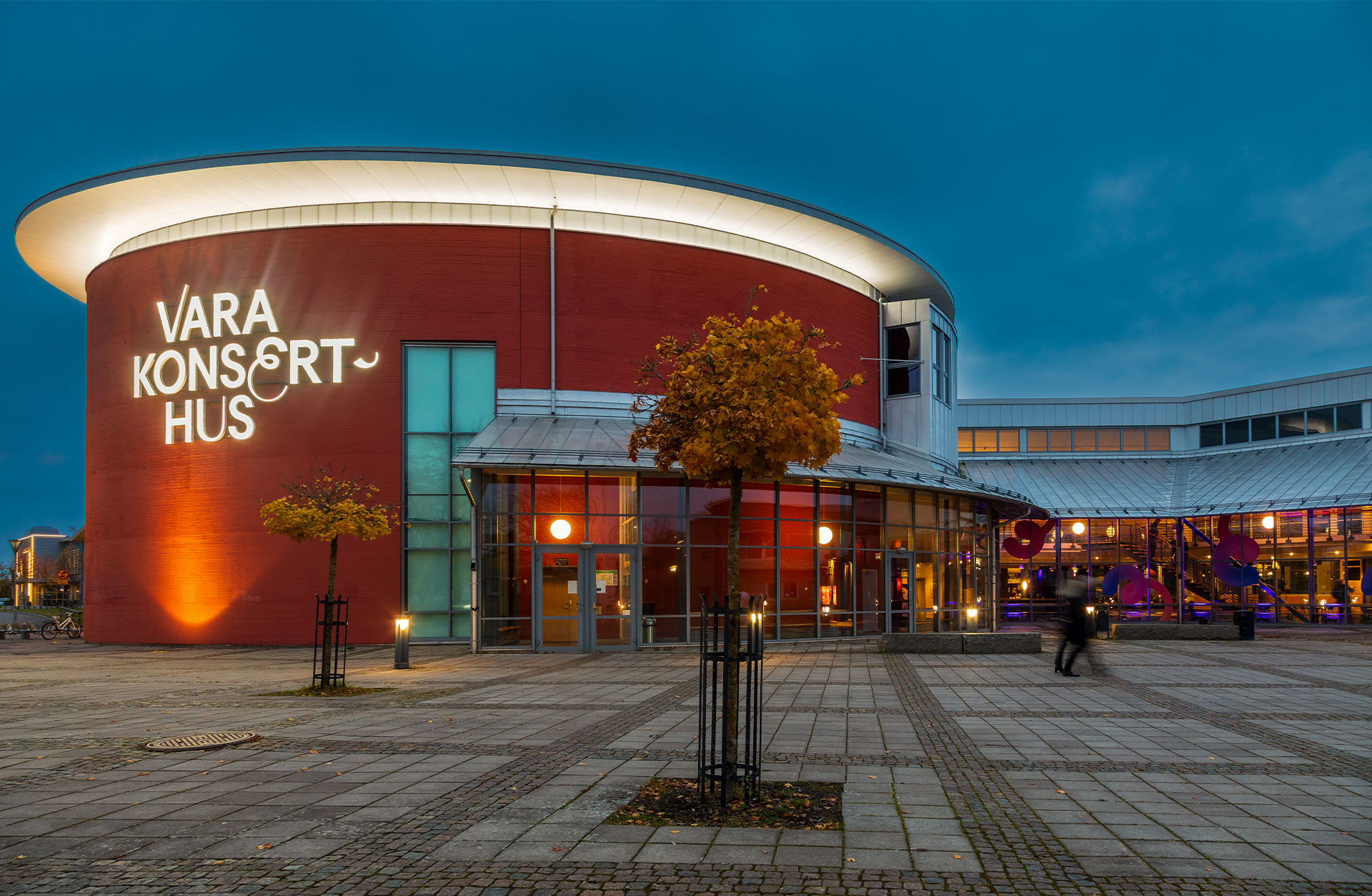
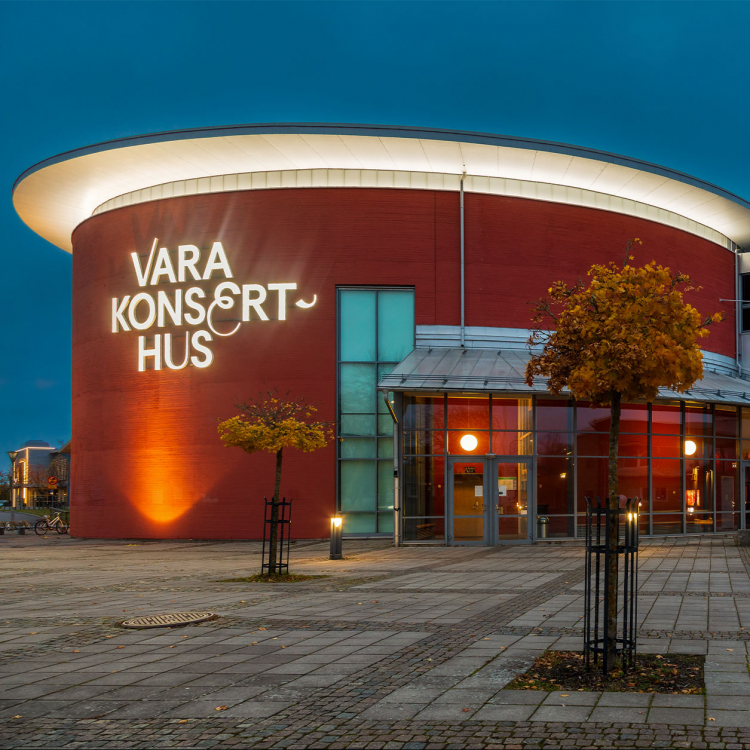
Vara Konserthus
Gothenburg Symphony Orchestra plays in Vara Konserthus
Event has already taken place. Gothenburgs Symphony Orchestra plays in Vara Konserthus together with conductor Patrik Ringborg and soprano Hanna Husáhr.
Rolf Martinsson (b 1956)
Ich denke Dein...
Nähe des Geliebten (Nearness of the Beloved)
Liebes-Lied (Love Song)
Blaue Hortensie (Blue Hydrangea)
Die Liebende schreibt (The Lover Writes)
Mondnacht (Moon Night)
Rolf Martinsson grew up in southern Sweden and his mother was a member of the singing group Göingeflickorna. He has been Malmö Symphony Orchestra's artistic advisor for many years and has been on the international stage since his trumpet concerto Bridge was first performed by Håkan Hardenberger in 1999. He has written a number of solo concertos and vocal works for Swedish soloists, above all for the soprano Lisa Larsson, to whom this work is dedicated.
The song cycle for soprano and orchestra Ich denke Dein... was a joint commission by five European orchestras in 2014 and includes a selection of the German poetry. The texts are written by Johann Wolfgang von Goethe, Joseph von Eichendorff and Rainer Maria Rilke. Their common theme is love. The first song, Nähe des Geliebten, opens with a strong emotional orchestral introduction that inserts a longing melodic theme. It also reappears as a short violin solo in the fourth song, Die Liebende schreibt, and in an interlude to the fifth, Mondnacht.
The two following poems are by Rainer Maria Rilke; Liebes-Lied from 1907 and Blaue Hortensie from 1906. Rilke then lived in Paris where he was secretary to the sculptor Auguste Rodin. He taught his collaborator to observe things like a plant, an animal or an object, to see what is essential and to combine it with his own feelings into a new image.
The beautiful poems are already full of music, says Martinsson. He has sought a suitable musical form where celesta, vibraphone, harp and piano bring light accents into the well-filled orchestra.
Intermission25 min
Wilhelm Stenhammar (1871–1927)
Symphony No 1
Wilhelm Stenhammar was a giant in Swedish musical life. One of the foremost pianists of his time, a successful conductor – during the years 1907–22 chief conductor of the Gothenburg Symphony Orchestra – and a brilliantly original composer. He dared a lot, but sometimes doubted his greatness. The most tangible expression of distrust towards his own creation was the withdrawal of the roughly fifty-minute-long and magnificently romantic First Symphony in F major.
Today it may seem strange, because it is a powerful and multifaceted work in an international style. The first movement recalls Brahms, Beethoven and, with the beautifully drawn-out anthemic melodies in the winds, also Bruckner. In the second movement, a rare beautiful melody in the oboe is combined with a finely chiseled string melody. Gradually, the vocal cords thicken and lead to an effective climax. The third movement, allegro amabile – “lovable allegro” is soft and warm, like a restrained scherzo, while the finale is solemn and powerful.
The first performance took place in December 1903 in the Music Academy's concert hall in Stockholm with the Concert Association's orchestra under the direction of Tor Aulin. The work then attracted strong approval. But, after hearing his friend Sibelius's second symphony and being overwhelmed, Stenhammar withdrew his symphony, saying it was far too impersonal and pompous. He wrote to Sibelius: “I have also written a symphony now. At least it's called a symphony. And according to an agreement, which you may have forgotten, it was to be dedicated to you. However, nothing will come of it.”
Not until January 1931, four years after the composer's death, the symphony was performed again in its entirety; first in Stockholm and soon also in Gothenburg.
Friday, 10 January 2025: The event ends at approx. 21.00
Participants
The Gothenburg Symphony was formed in 1905 and today consists of 109 musicians. The orchestra's base is Göteborgs Konserthus, the funk gem at Götaplatsen that has gathered music lovers since 1935. Since the 2017-2018 season, Santtu-Matias Rouvali has been Chief conductor of the Gothenburg Symphony. Since the 2019-2020 season, Barbara Hannigan is Principal guest conductor. We are also a proud partner of Barbara Hannigan's Equilibrium mentoring program focusing on young singers at the start of their careers.
Wilhelm Stenhammar was the orchestra's chief conductor from 1907 to 1922. He gave the orchestra a strong Nordic profile and invited colleagues Carl Nielsen and Jean Sibelius to the orchestra. Under the direction of conductor Neeme Järvi from 1982-2004, the orchestra made a series of international tours as well as a hundred disc recordings and established themselves among Europe's leading orchestras. In 1996, the Swedish Riksdag appointed the Gothenburg Symphony as Sweden's National Orchestra.
In recent decades, the orchestra has had prominent chief conductors such as Mario Venzago and Gustavo Dudamel, following Kent Nagano as Principal Guest conductor. Anna-Karin Larsson is CEO and artistic director, Gustavo Dudamel honorary conductor and Neeme Järvi chief conductor emeritus. The orchestra's owner is the Västra Götaland Region.
The Gothenburg Symphony works regularly with conductors such as Herbert Blomstedt, Joana Carneiro, Jukka-Pekka Saraste, Christian Zacharias and Anja Bihlmaier.
Patrik Ringborg is one of Sweden's most prolific conductors with over 90 conducted operas and an extensive concert repertoire. He was appointed general music director at the State Theater in Kassel in 2007 and remained in this position for a decade. Patrik Ringborg has conducted over 30 German orchestras and in many other countries, including all the major Swedish orchestras. Gothenburg Opera appointed him as first guest conductor after his debut in 1998 with Tannhäuser. He subsequently conducted all Wagner productions there until 2006, returning with Salome, Notorious (world premiere), Ariadne and Herr Arnes Penningar.
Patrik Ringborg has been a regular guest at the Royal Philharmonic in Stockholm and conducted the Nobel Prize ceremony in 2008 and the award ceremony for Birgit Nilsson Prize for Yo-Yo Ma in 2022. At the Royal Opera in Stockholm, he has conducted a new production of Parsifal directed by Christof Loy and in 2016 he returned to conduct the world premiere of Daniel Börtz's Medea. He has been a guest at Malmö Opera since 1992 and is Principal guest conductor since 2022. In recent seasons, Ringborg has conducted symphonies by Stenhammar, Alfvén and Sibelius with the Royal Philharmonic Orchestra, Stenhammar's Sången with the Radio Symphony Orchestra, been a recurring guest at NSO Dublin (most recently in Tchaikovsky's Fifth Symphony), conducted several opera premieres in Malmö and led the first complete performance of Alfvén's Bergakungen with MSO. During 2025, he conducts the Wiener Symphoniker in 13 performances of von Weber's Friskytten at the Bregenz Festival as well as new productions of Salome and Lohengrin at Malmö Opera. In 2023 he was awarded the Royal Academy of Music's Alfvén medal in gold.
He was last conducting Gothenburg Symphony Orchestra at the National Day concert in Slottsskogen in 2022.
The Swedish soprano Hanna Husáhr studied at the Guildhall School of Music and Drama in London and continued as a trainee at the Finnish National Opera. With repertoire ranging from Handel and Mozart to Donizetti's Lucia and Adams' Pat Nixon, she has sung with opera companies and orchestras worldwide. Current engagements include Gilda in Rigoletto and the title role in Mats Larsson Gothe's opera Löftet conducted by Alan Gilbert, both at the Royal Opera House in Stockholm, as well as Mozart's Requiem with the Malta Philharmonic Orchestra conducted by Lawrence Renes.
Highlights in recent seasons include Ein deutsches Requiem by Brahms with the Swedish Radio Symphony Orchestra, Peter Grimes with the Bergen Philharmonic Orchestra at the Norwegian National Opera and Royal Festival Hall in London conducted by Edward Gardner, Pamina in Trollflöjten at the Royal Opera in Stockholm, Mahler's Symphony No. 8 at the Edinburgh International Festival, Sophie in Werther by Massenet at Bergen National Opera, Woglinde in Das Rheingold at New Opera in Esbjerg, Céphise in Pygmalion at Drottningholmsteatern and Greta in Hans and Gretel at Malmö Opera.
Hanna Husáhr is often engaged as a concert singer with repertoire from early baroque to contemporary.

 031-726 53 00
 biljett@gso.se