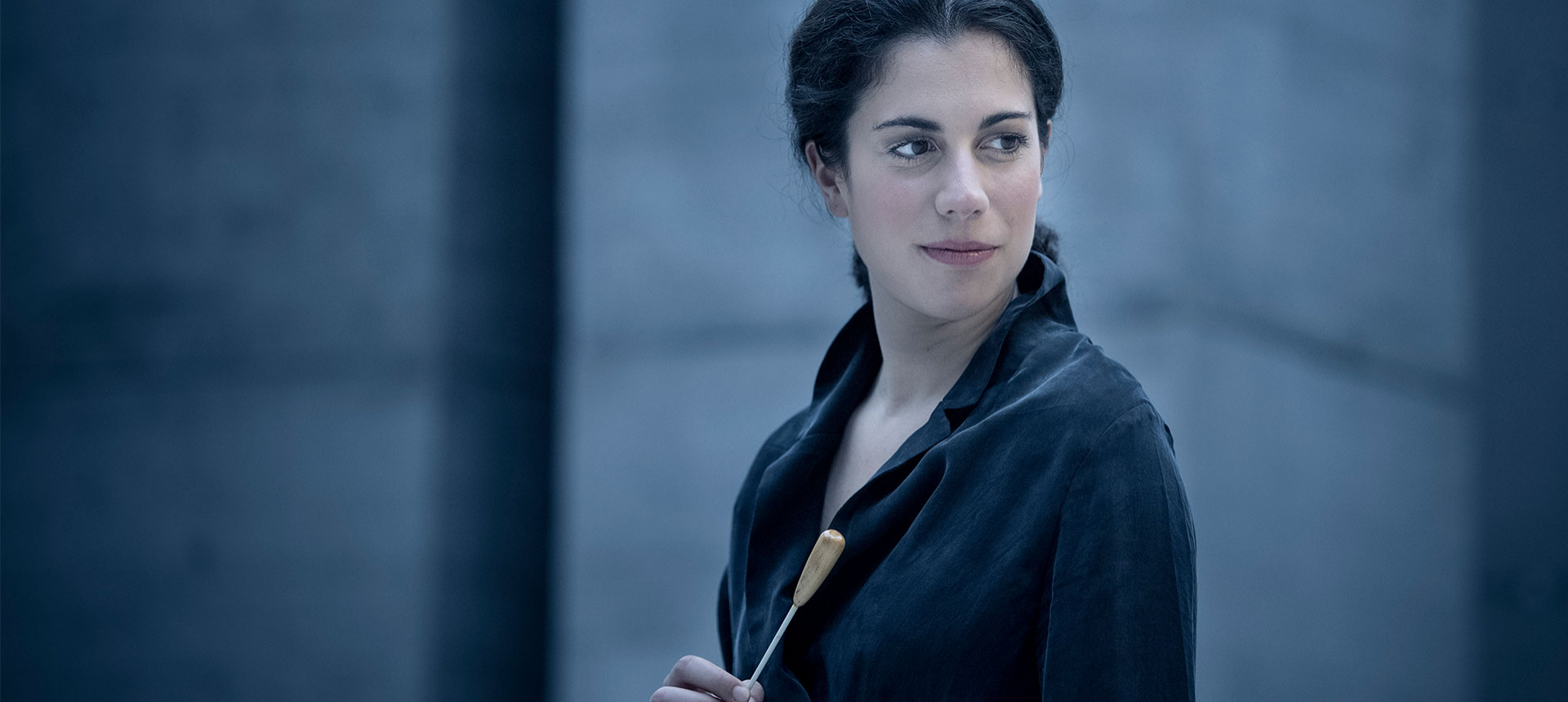
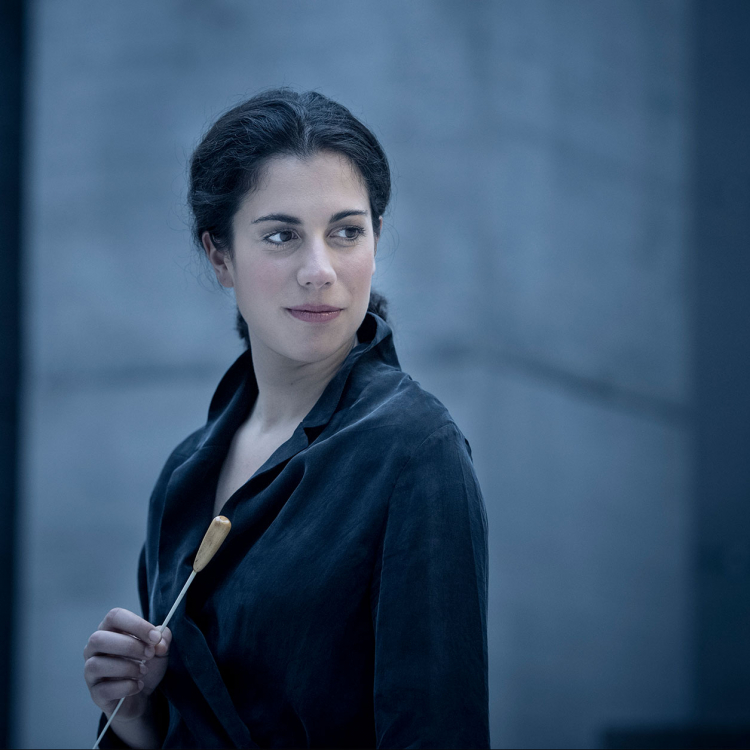
Meet the acclaimed French conductor Marie Jacquot who leads the Gothenburg Symphony in Ravel’s richly ornamented and elegant Valses nobles et sentimentales. Swedish Peter Jablonski is the soloist in Polish Grażyna Bacewicz’s late-romantic, virtuosic and dreamily imaginative piano concerto.
Grażyna Bacewicz was both celebrated and uniquely successful as a female composer during her lifetime. She graduated in composition at the Warsaw Conservatory and combined her composing with life as a touring piano soloist until the mid-1950s. After that, she devoted herself exclusively to composing. She wrote the concerto for piano and orchestra from 1949 for the 100th anniversary of the death of compatriot Frédéric Chopin.
The evening ends in the same romantic spirit with César Franck’s only full-scale symphony, the Symphony in D minor, which premiered at the end of the vibrant 1880s.
Peter Jablonski made a big breakthrough in his 20s and has been an internationally acclaimed artist for many years. He is one of the leading pianists of his generation and has performed with over 150 major orchestras and conductors over the past 30 years. To our delight, he is now making a long-awaited return visit to the Gothenburg Symphony.
Listen
Get toknow the classicalpieces.
Introduction to the concert
Take a seat in the Great Hall one hour before the concert begins and learn more about the music you will soon experience! You will get the stories behind the music, knowledge of the composers and own reflections about the classical pieces. The introduction last for about 30 minutes, it is free and free seating in the hall. Warm welcome!
Programme
VALSES NOBLES ET SENTIMENTALES
Modéré - Assez lent - Modéré - Assez animé - Presque lent - Assez vif - Moins vif - Epilogue: Lent
When Claude Debussy heard Ravel's Valses nobles et sentimentales in 1911 he exclaimed: "He has the finest ear anyone ever had!" Ravel was himself aware that this time he had composed something very special. "The title Noble and sentimental waltzes reveal my intentions to compose a series of waltzes such as, for example Schubert did it," wrote the composer. But there ends the innocent comparison, because these eight pieces are packed with harmonic dynamite, which when it exploded made contemporary listeners mad and upset. You can't compose like this!
Debussy had only heard the original piano version, for Ravel did not write the elegant and ingenious orchestral ring until the following year. The music also came to be used for the ballet Adélaïde performed at the Châtelet in Paris on 22 April 1912 with the composer as conductor.
Today we have gotten used to the piece's piquant French seasoning and can easily make us fall in love with the scents that the contemporaries were appalled by. The eight movements are played without pause and contains great contrasts in rhythmicity within the three-stroke model of the waltz. The suite ends with an epilogue, a slow, dreamy, surreal waltz where the harmonic refinement reaches its peak. Much later, in 1920, Ravel completed yet another "choreographic poem" with three measures - La Valse.
Grazyna Bacewicz (1909-1969)
Concerto for piano and orchestra
It was to commemorate the 100th anniversary of Frédéric Chopin's death that Grazyna Bacewicz composed her captivating piano concerto in 1949. With a length of around 20 minutes, the concerto is imbued with Bacewicz's unmistakable combination of bold strokes and formal precision, with Polish folk music running like a common thread through the piece. The opening movement is based on two contrasting themes inspired by traditional Polish songs. The dialogue between the piano and the orchestra fluctuates and the movement ends with a wild cadence.
The second movement is also based on Polish folk music, here through variations on the song Oj chmielu, chmielu, before the music rises to a kaleidoscopic finale. In addition to being a composer, Bacewicz was an accomplished pianist and she often performed her piano pieces herself. She had an extraordinary work pace, and in 1949, in addition to the piano concerto, she also wrote her first piano sonata, a quartet for four violins, Kaprys Polski for violin and orchestra and her fourth sonata for violin and piano. The premiere of the piano concerto took place in November 1949 with Stanislaw Szpinalski and the Warsaw Philharmonic Orchestra conducted by Andrzej Panufnik. In 2023, Peter Jablonski released the piano concerto on disc in a recording with several works by Bacewicz with the Finnish Radio Symphony Orchestra (Ondine).
Hedvig Ljungar
Intermission25 min
Lento. Allegro non troppo
Allegretto
Allegro non troppo
César Franck was actually born in Liège, Belgium, but from the age of 13 lived in Paris, where he eventually worked as a beloved and respected pedagogue and as one of the most brilliant organists of his time. During his last 10-15 years of life, he entered a completely new and mature phase as a composer, and around ten new organ works from that time came to revolutionize the genre. His violin sonata in A major became one of the most played masterpieces of the chamber literature, and his symphony in D minor is a marvel in its synthesis of Germanic chromaticism and Gallic elegance.
Franck's greedy father did everything to launch the boy in Paris as a child prodigy of Mozart's caliber. Undoubtedly, he was talented, and as a youth he created a rich output of simpler organ works, chamber music, piano concertos and oratorios - but all these works have remained relatively unknown, and he could not reap any major success.
In 1859 he obtained a more secure position as organist in the Paris church of St Clotilde, where the legendary organ maker Cavaillé Coll had just built a magnificent instrument. Franck would work there for 33 years! This was a time when French church music, thanks to Gounod, Saint-Saëns, Widor, Fauré and many others, experienced a high point, and Franck also composed good-sounding but not liturgical masses and oratorios. What actually happened towards the end of the 1870s is difficult to say, but Franck's music unexpectedly took on an increasingly passionate and full-throated tone, at the same time that he expressed himself in genres that were not at all popular in the France of the time. Most tried to find happiness as opera composers, but opera was the only form of music Franck completely missed. Instead, he focused on chamber music and orchestral music, including what would become one of the most played French symphonies.
The tonal language of the symphony is charged with an almost religious mysticism and contains plenty of swarming modulations, quite foreign to the French tradition. Who could have guessed that this peaceful man would develop into a revolutionary? But he didn't want to subvert, just write honest music, as he felt it inside.
The symphony alternates between darkness and light, between hope and despair, not to say ecstasy. The music is very personal, something that the premiere audience in 1889 (the year before his death) had a hard time coming to terms with. Even colleague Charles Gounod said that the symphony reflected an "impotence driven to dogmatism". The director of the Paris Conservatoire was amazed by the instrumentation: "when did you ever hear a symphony with an English horn?" - the lovely elegiac main theme in the same long movement is presented by this instrument. The director had apparently forgotten that the English horn already appeared in Berlioz's Symphonie fantastique. For those with open ears, Franck's symphony was a revelation, and remains so to this day. A unique product of the highest class.
Stig Jacobsson
Wednesday, 20 September 2023: The event ends at approx. 21.30
Friday, 22 September 2023: The event ends at approx. 20.00
Participants
The Gothenburg Symphony Orchestra was founded in 1905 and currently consists of 109 musicians. The orchestra is based in Gothenburg Concert Hall – a gem of functionalism on Götaplatsen square that has enchanted music lovers since 1935. Wilhelm Stenhammar was the orchestra’s Chief Conductor from 1907 until 1922. He gave the Gothenburg Symphony Orchestra a strong Nordic profile and invited his colleagues Carl Nielsen and Jean Sibelius to collaborate with the orchestra. Under the leadership of Chief Conductor Neeme Järvi between 1982 and 2004, the Gothenburg Symphony Orchestra undertook a number of international tours and made a hundred or so album recordings while establishing itself as one of Europe’s foremost orchestras. In 1997 the Gothenburg Symphony Orchestra received the title of the National Orchestra of Sweden.
Since season 2017-2018 Santtu-Matias Rouvali is Chief Conductor of the Gothenburg Symphony Orchestra. Since season 2019-2020 Barbara Hannigan is Principal Guest Conductor. Christoph Eschenbach was also Principal Guest Conductor of Gothenburg Symphony in the years 2019-2022 – together they formed a strong three-leaf clover consisting of three completely different types of artists. We are also extremely proud to be an official partner of soprano Barbara Hannigan’s mentor initiative Equilibrium, with focus on young singers and musicians who are just beginning their careers.
Sten Cranner is the orchestra’s CEO and Artistic Director, while Gustavo Dudamel holds the title of Honorary Conductor and Neeme Järvi that of Principal Conductor Emeritus. Region Västra Götaland is owner of the orchestra. The Gothenburg Symphony Orchestra works regularly with conductors such as Herbert Blomstedt, Joana Carneiro, Jukka-Pekka Saraste, Christian Zacharias and Anja Bihlmaier.
Marie Jacquot is from 2023-2024 Principal Guest Conductor of the Wiener Symphoniker. She will also take on the post of Principal Conductor of the Royal Danish Theatre Copenhagen in August 2024. She has developed a continuous collaboration with orchestras like DSO Berlin, where she made her debut in 2018, and Wiener Symphoniker, with which she has been guest at Bregenz Festival, as well as at Vienna’s Musikverein and Konzerthaus.
Marie Jacquot‘s 2022-2023 season started with her debut at the Opéra National du Rhin Strasbourg and further highly acclaimed debuts with the Symphony Orchestras of Bavarian Radio Munich, WDR Cologne and HR Frankfurt, as well as the Staatskapelle Dresden.
Marie Jacquot was first conductor at the Deutsche Oper am Rhein Düsseldorf / Duisburg for three years, where she conducted performances in a wide repertoire, including the new productions La clemenza di Tito, Roméo et Juliette and The Nutcracker, as well as concerts by the Düsseldorf Symphony Orchestra and the Duisburg Philharmonic Orchestra.
In 2016, Marie Jacquot was assistant to Kirill Petrenko at the Bavarian State Opera for the world premiere of Miroslav Srnka's South Pole (directed by Hans Neuenfels), following which she was invited to conduct two world premieres at the Munich Opera Festival.
After studying trombone in Paris, Marie Jacquot studied conducting in Vienna and Weimar. Her awards include the Ernst Schuch Prize in 2019, as well as a nomination as Newcomer of the Year at the International Opera Awards.
The concert is Marie Jacquot's debut with the Gothenburg Symphony.
The last time we heard Peter Jablonski play with the Gothenburg Symphony was in 2009 and we are very happy to have him back. Peter Jablonski is one of the leading pianists of his generation and a well-known profile in Swedish musical life. For 30 years, he has performed with over 150 orchestras and given over 2 000 concerts. Signed to Decca at the age of 17, he began performing and recording with many of the world's leading orchestras such as the BBC Symphony Orchestra, Royal Philharmonic Orchestra, Swedish Royal Philharmonic Orchestra, Leipzig Gewandhausorchester, La Scala Philharmonic, Orchester Nationale de France and Tonhalle Zurich.
He has performed in venues such as the Royal Festival Hall and Barbican in London, Suntory Hall Tokyo, Philharmonie Berlin, Hollywood Bowl Los Angeles, Salle Pleyel Paris, Musikverein Vienna and Concertgebouw in Amsterdam among many others. He has performed and recorded all the piano concertos by Beethoven, Tchaikovsky, Rachmaninov and Bartók, and all the piano sonatas by Prokofiev. During his three-decade career, he has developed a diverse repertoire that includes works by Barber, Gershwin, Szymanowski and Stenhammar, with later additions such as Valborg Aulin, Elfrida Andrée, Alexey Stanchinsky and Grazyna Bacewicz. Peter Jablonski has worked with composers such as Witold Lutoslawski and Arvo Pärt, and has had a number of works written for him, including Wojciech Kilar's Piano Concerto for which he won the Orpheus Prize at the Warsaw Autumn Festival.
In 2022 he joined a project where he will perform and record the music of composer Karol Szymanowski as well as participate in a film about Szymanowski's life and work.
 031-726 53 00
 biljett@gso.se