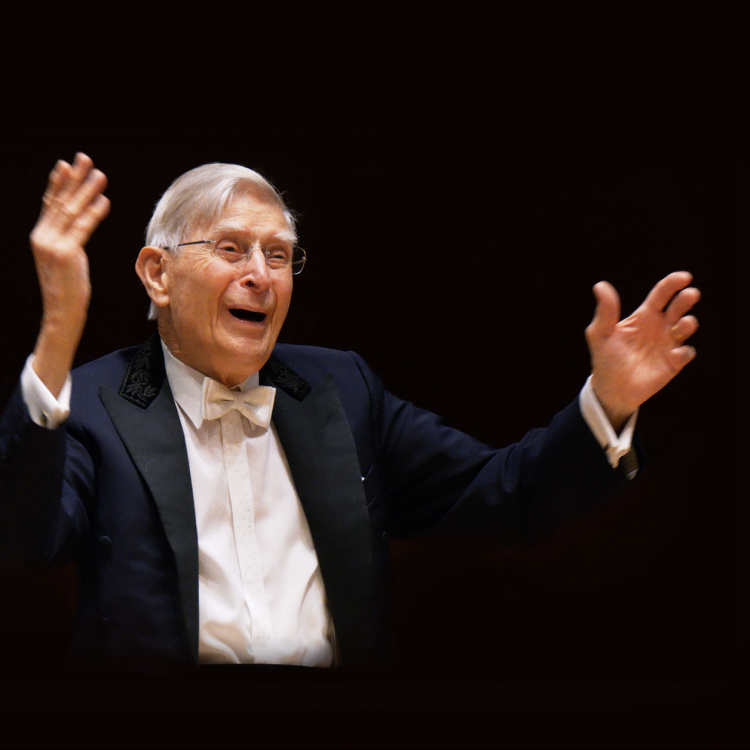
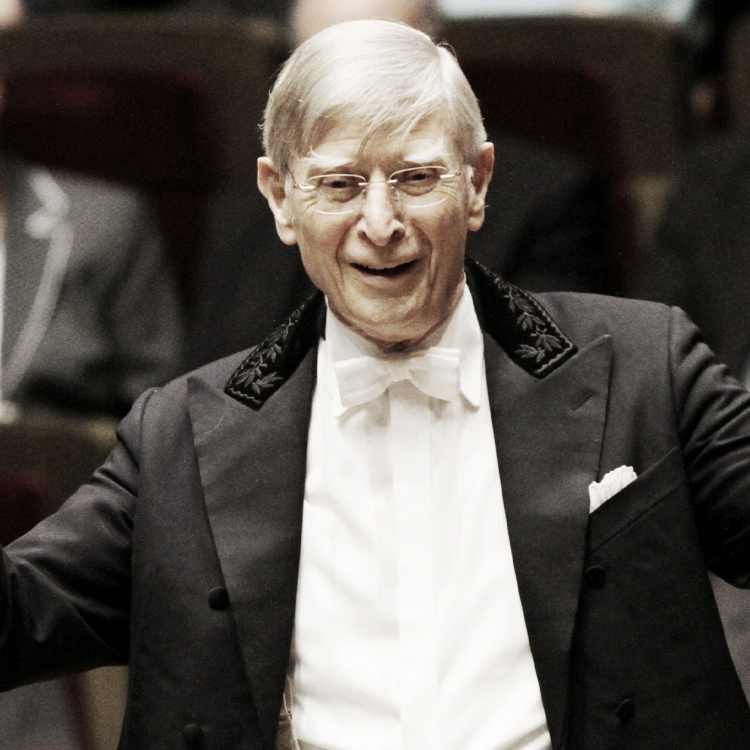
Symphonies No. 2 and 7 as you like it. Hear Beethoven interpreted with love and the wisdom of an entire lifetime. The esteemed conductor Herbert Blomstedt takes his place on the podium once again in his 70-year relationship with the Gothenburg Symphony Orchestra.
Herbert Blomstedt is celebrated for his complete recordings of Beethoven’s symphonies. “Precise, powerfully flowing and filled with tension.” The Swedish legend now looks back on a career of over 70 years as conductor of the world’s foremost orchestras. A work that began with the Gothenburg Symphony Orchestra already in 1953.
Hear an entire lifetime of work and passion shaped into music as two stars shine together: Beethoven in the score and Blomstedt on the podium.
Listen
Get to know the music.
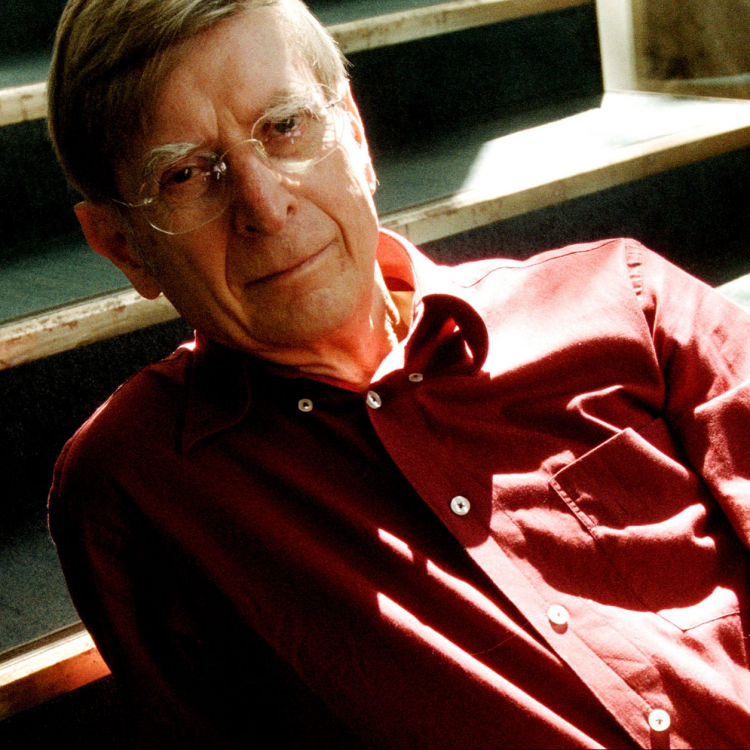
Get to know Herbert Blomstedt.
Introduction to the concert
Take a seat in the Great Hall onehourbefore the concertbegins and learnmoreabout the musicyouwillsoonexperience! Youwill get the storiesbehind the music, knowledgeof the composers and ownreflectionsabout the classicalpieces. The introductionlast for about 30 minutes, it is free and freeseating in the hall. Welcome!
Programme
Ludwig van Beethoven (1770-1827)
Symphony No 2
On the advice of doctor Schmidt, Beethoven settled down in the summer of 1802 in the rural peace of Heiligenstadt, one of the suburbs of Vienna. Within him, however, he had anything but peace. He sensed the hearing loss that would soon render him completely deaf, and towards autumn he wrote to his brothers the shocking letter commonly known as the Heiligenstadt Testament, which reveals him as a man on the verge of suicide. But you don't notice much of the anguish of the soul in the music he wrote at this time, especially not in the second symphony. This is essentially light and cheerful music, and the larghetto is one of his happiest expressions.
The wide-ranging first movement opens with an Adagio molto that contains more soulful preparation than any similar movement in previous symphonies, and the two opening, marked notes D then reappear in different guises throughout the first movement. That Beethoven then presents the main theme in the low strings was a startling novelty. and some listeners found the contrast with the second theme's marching rhythm too brutal. The slow movement of the first symphony is based almost entirely on a single theme, but the corresponding movement of the second symphony blossoms into an overwhelming richness of lovely melodies and rhythmic piquancy. Beethoven later claimed that he was able to create 20 works from these thematic ideas.
This is followed by his first symphonic scherzo. In chamber music contexts, however, he had already written several scherzos, and the minuet in the first symphony certainly also has the character of a scherzo, even if it has not taken the full step. In the finale, the master takes the liberty of beginning on the dominant, only to lead the music in the main key in the third measure. Irresistible rhythmic power, daring interval leaps and radiant good mood distinguish the music.
Intermission25 min
Ludwig van Beethoven (1770-1827)
Symphony No 7
Half Viennese classicist, half romantic, but mostly Beethoven. That's how we're used to seeing him, but he had other sides as well. In both the 6th and 7th symphonies, the folklorist Beethoven appears. In the former he depicts dancing peasants (third movement), and in the seventh symphony he delivers a finale built around a folk dance. Of course, in Beethoven's artful and powerful arrangement - he is incredibly driving, thrusting with weight and force into the chords at an accelerating pace. This restless, rhythmic rondo is one of his most explosive creations.
The symphony opens slowly, with upward movements (fast versus slow) contrasted with a pretty, dancing trio. Note Beethoven's orchestral dramaturgy as he strips away the score from the full orchestra until only a flute and an oboe remain.
Then the main theme takes over, heralding the 9th Symphony's An die Freude. In the thematic development work, one can often discern the struggle of the lonely against the many, a constantly recurring theme in Beethoven's music.
The well-known allegretto in movement two is definitely the symphony's pièce de résistance. This variation movement must have seemed like a very strange animal in Beethoven's time: an evocative passacaglia with a rhythmic figure - one long, two short, two long - pulsating throughout the movement. Above this, Beethoven weaves and develops new parts that increase in strength and scope and then thin out and tone down. The swells are crowned by a couple of solid climaxes. This is Bach and the future at once, the innovative polyphony that would blossom fully in the late string quartets and piano sonatas.
The third movement is a scherzo to everything but the name – never have boisterous male laughter (the low strings) and female laughter cascades (the woodwind) been depicted so vividly as here. Beethoven also achieves unusual harmonic effects when he lets the trumpets lie on pedal notes above (reversed!) the melody in the rest of the orchestra.
The symphony was first performed on 8 December 1813 together with the almost farcical commissioned work Wellington's Victory, including crevados, cannons and a fugato on God save the King. There is no doubt as to which work is the better.
Wednesday, 9 April 2025: The event ends at approx. 21.30
Thursday, 10 April 2025: The event ends at approx. 21.30
Participants
The Gothenburg Symphony was formed in 1905 and today consists of 109 musicians. The orchestra's base is Göteborgs Konserthus, the funk gem at Götaplatsen that has gathered music lovers since 1935. Since the 2017-2018 season, Santtu-Matias Rouvali has been Chief conductor of the Gothenburg Symphony. Since the 2019-2020 season, Barbara Hannigan is Principal guest conductor. We are also a proud partner of Barbara Hannigan's Equilibrium mentoring program focusing on young singers at the start of their careers.
Wilhelm Stenhammar was the orchestra's chief conductor from 1907 to 1922. He gave the orchestra a strong Nordic profile and invited colleagues Carl Nielsen and Jean Sibelius to the orchestra. Under the direction of conductor Neeme Järvi from 1982-2004, the orchestra made a series of international tours as well as a hundred disc recordings and established themselves among Europe's leading orchestras. In 1996, the Swedish Riksdag appointed the Gothenburg Symphony as Sweden's National Orchestra.
In recent decades, the orchestra has had prominent chief conductors such as Mario Venzago and Gustavo Dudamel, following Kent Nagano as Principal Guest conductor. Anna-Karin Larsson is CEO and artistic director, Gustavo Dudamel honorary conductor and Neeme Järvi chief conductor emeritus. The orchestra's owner is the Västra Götaland Region.
The Gothenburg Symphony works regularly with conductors such as Herbert Blomstedt, Joana Carneiro, Jukka-Pekka Saraste, Christian Zacharias and Anja Bihlmaier.
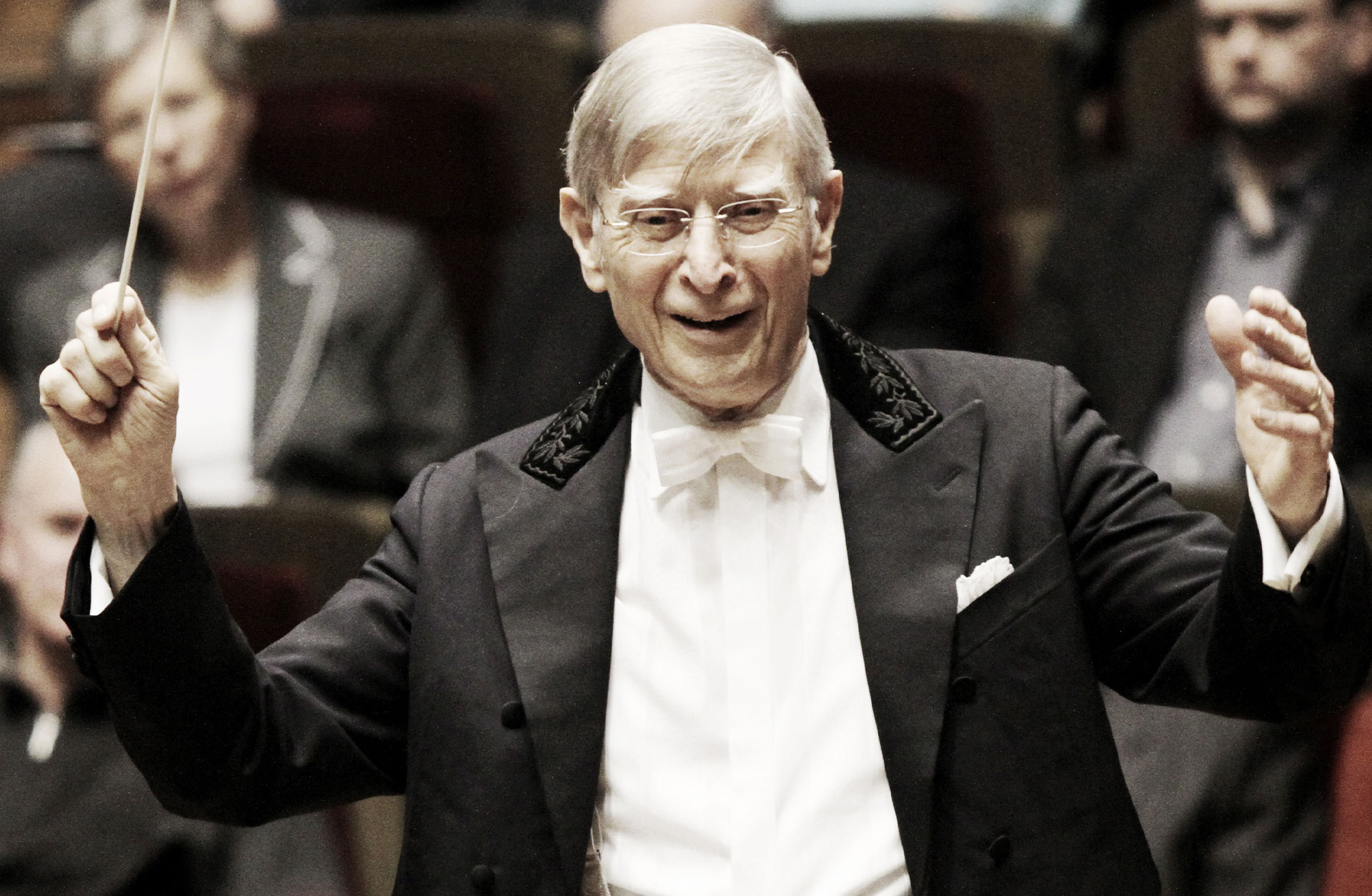
Despite his record-breaking age, Herbert Blomstedt, born in 1927, continues to be one of the world's most sought-after conductors. He has been a regular and much appreciated guest conductor with the Gothenburg Symphony since 1954 and is also named an honorary symphony conductor. His work as a conductor is inextricably linked to his religious and human ethos, and his interpretations combine great fidelity to the score and analytical precision. In the more than sixty years of his career, he has acquired the unrestricted respect of the musical world.
Born in the USA to Swedish parents and educated in Uppsala, New York, Darmstadt and Basel, Herbert Blomstedt made his debut as a conductor in 1954 with the Stockholm Philharmonic Orchestra and was subsequently chief conductor of the Oslo Philharmonic, the Swedish and Danish Radio symphony orchestras and the Staatskapelle Dresden. During his career, Herbert Blomstedt has been chief conductor of the Gewandhaus Orchestra in Leipzig, the NDR Orchestra in Hamburg and the San Francisco Symphony Orchestra. He has appeared with all the major orchestras, including the Berlin Philharmonic, the Boston and Chicago Symphony Orchestras, the Concertgebouw Orchestra, the New York Philharmonic, the Bavarian Radio Symphony Orchestra and the Vienna Philharmonic. Herbert Blomstedt's discography includes hundreds of recordings. Among his later releases are Stenhammar's Serenade and Symphony No. 2 with the Gothenburg Symphony (BIS).
Herbert Blomstedt holds several Honorary Doctorates and is an elected member of the Royal Swedish Music Academy. He continues to be at the helm of all leading international orchestras with enormous presence, verve and artistic drive.


 031-726 53 00
 biljett@gso.se