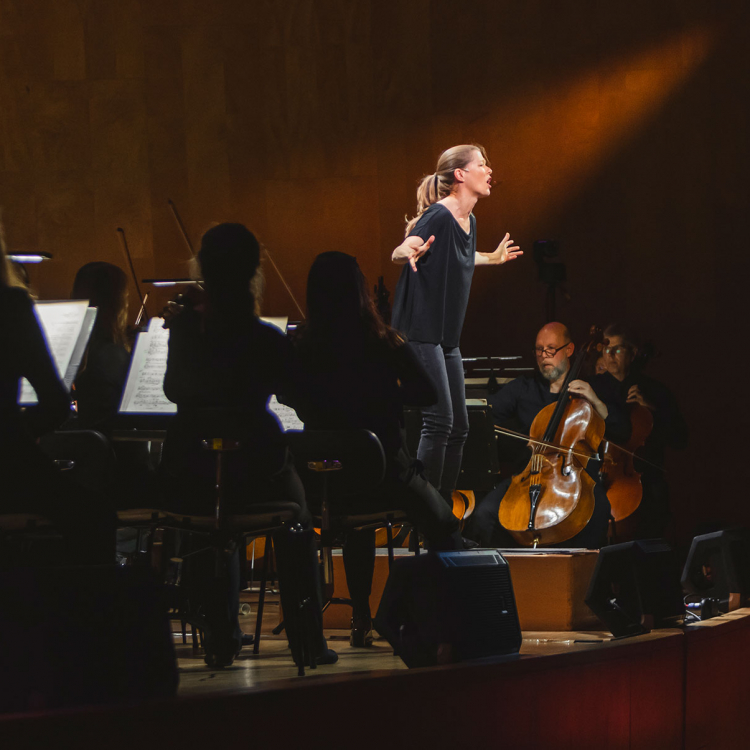
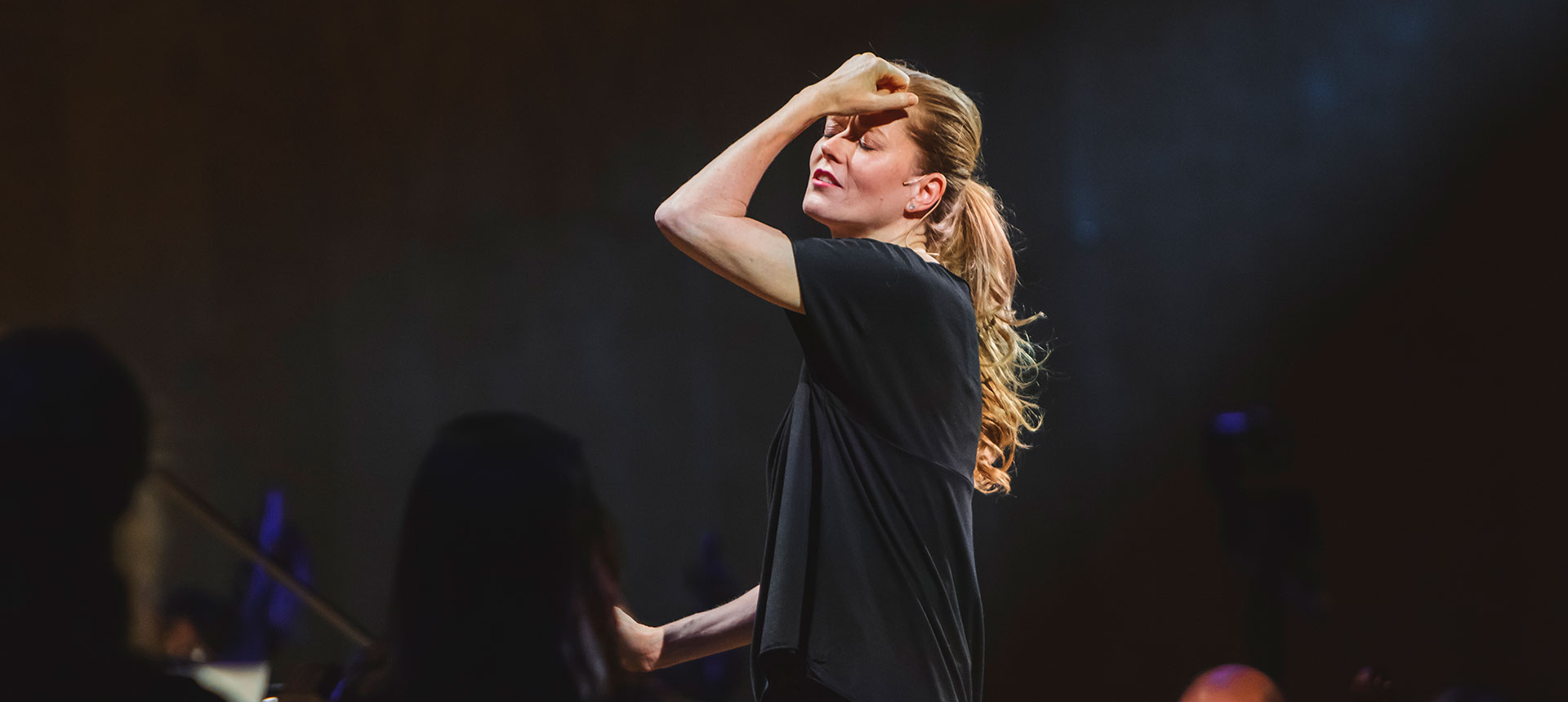
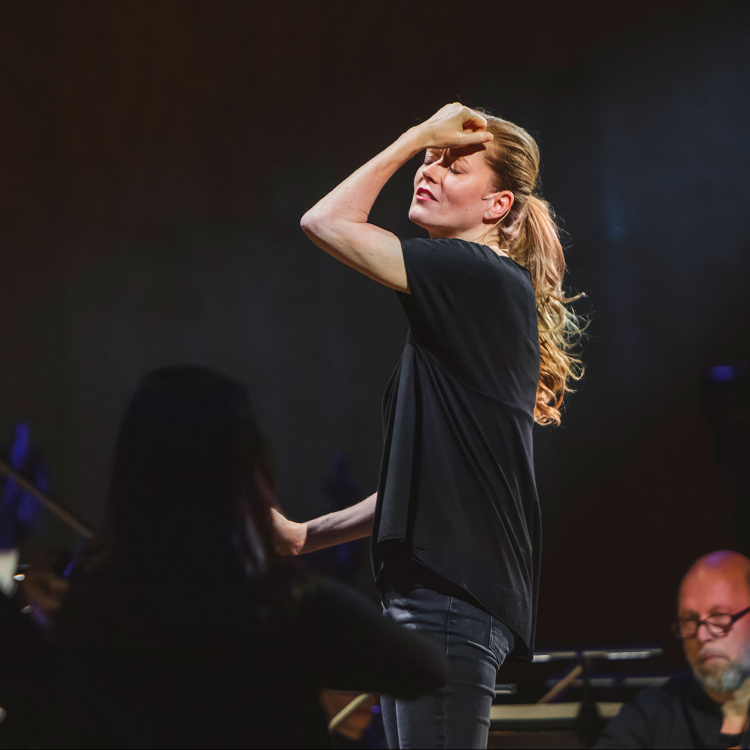
Event has already taken place. There’s room for every emotion when the Gothenburg Symphony meets Barbara Hannigan - she conducts and sings with dazzling mood and technique!
Concert length: 2 h 15 min incl. intermission
Stage: Stora salen
380-540 SEKStudent 190-270 SEK
Young up to 29 190-270 SEK
Delightful, exciting, fun, exuberant; all emotions find their place in Barbara Hannigan’s willful program with music by Rossini, Britten, Stravinsky and Prokofiev. Our first guest conductor conducts and sings with dazzling mood and technique.
The evening is characterized by singing and popular dance. It opens with tones by Sergei Prokofiev, who wrote his first symphony in a classicist style: cheerful, humorous and melodious.
Then an abrupt swich to 20th century opera giant, Benjamin Britten. The songs in the song cycle Les Illuminations were originally written for tenor, but are now performed by Hannigan’s vital soprano voice.
After the break, we meet the overture to Semiramide by Gioachino Rossini, where no one can resist the singable melodies of the horns. Next is Igor Stravinsky’s wind octet written in 1923, a modernist breakthrough with elements of both polka and march, of teasing counterpoint and jazzy syncopations. The master of classicism, Joseph Haydn, closes the circle around this musical family with his majestic London Symphony.
Listen
Get to know the classical pieces.
Introduction to the concert
Take a seat in the Great Hall one hour before the concert begins and learn more about the music you will soon experience! You will get the stories behind the music, knowledge of the composers and own reflections about the classical pieces. The introduction last for about 30 minutes, it is free and free seating in the hall. Warm welcome!
Programme
Prokofiev was both an experienced and successful composer when a symphony came to the fore. He had composed a couple of piano concertos, a violin concerto, an unpublished opera (Maddalena) and a couple of ballets. Much of this music was of the grandiose kind with imaginative and pompous orchestral arrangements. Now it was time for a new twist. The summer of 1917 was spent in the countryside outside Petrograd, today St. Petersburg (Leningrad in between), where there was no piano. We'll let Prokofiev tell it himself:
"I got the idea to compose a symphonic work without a piano. In this way, the orchestral colors would necessarily be clearer and purer. That's how the plan to make a symphony in the Haydn style arose because as a result of my studies in Cherepnin's conducting class, I discovered Haydn's technique, and with such an insight it was much easier to dive into the dangerous river without a piano. It seemed to me that if he had lived today, Haydn with his style of composition would have caught something of the modern as well. It was such a symphony I wanted to compose: a symphony in the classical manner. When it began to take shape it was called The Classical, first because it was the easiest, second because of stubbornness, to stir up the wasp's nest, and finally in the hope that the symphony in time would really become 'classic', which would be of great benefit to me."
And indeed, "The Classic" has become "classic" - one of Prokofiev's most successful works ever since he conducted the premiere in Petrograd on April 21, 1918.
STEFAN NÄVERMYR
Benjamin Britten (1913-1976)
Les Illuminations Op 18
Fanfare · Villes · Phrase · Antique · Royauté · Marine · Interlude · Being Beauteous · Parade · Départ
Arthur Rimbaud was one of the young geniuses of French poetry. He said: “I am an inventor, far more deserving than all those who went before me; a musician who found something resembling the key of love.” In 1874, this young writer wrote the collection Les Illuminations, and it became a turning point in French poetry. The strange thing is that the author was a young man not yet 20 years old, and even more strange is that this was his last work. The surrealists were powerfully influenced by the visions of the poems and their previously unknown intensity and power of expression. Here there is a new language rhythm and a flourishing vocabulary.
It is also not surprising that these poems have been a source of inspiration for several contemporary composers, and one of those who succeeded best is Benjamin Britten, who was also very early as an artist, and who in 1939 set Rimbaud's Les Illuminations (Illuminations) to music for soloist and strings. "I have strung ropes from bell tower to bell tower, garlands of flowers from window to window, chains of gold from star to star, and I dance."
As a refrain and as an incantation, Britten repeats regularly: "I alone hold the key to this wild game of fun". A word artist and a sound artist have been united in a meaningful synthesis.
Stig Jacobsson
Intermission25 min
Gioachino Rossini (1792-1868)
Semiramide: Overture
Rossini's opera overtures are deservedly popular. Charming and melodious, they always manage to warm up an audience, with The Barber of Seville and Wilhelm Tell as the crowning glory. Semiramide was Rossini's last opera in Italy and he would shortly thereafter be enlisted as theater director in Paris. But before that, he transformed this Voltaire play into a bel canto-style singing party set in ancient Babylon. The overture moves from a rhythmic intro to an andantino for horns picked up by pizzicatto strings to end in a cheerful allegro. The premiere was held in Venice in 1823.
IGOR STRAVINSKY (1882-1971)
Octet for wind instruments
Sinfonia
Theme with variations
Finale
(movements two and three are played consecutively)
Stravinsky has spoken in many different ways about his wind octet, but perhaps the most telling is this quote:
"The octet began with a dream. I found myself in a small room surrounded by a small number of musicians playing a most pleasant music. I did not recognize the music they were playing, nor could I remember anything about that day. I remembered my curiosity - in the dream - about how many musicians there were. I also remembered that I then counted them to eight. They played bassoons, trombones, trumpets, flute and clarinet. I woke up from this little dream concert very satisfied, and the next morning I began to compose the octet - a piece I hadn't given so much as a thought to the day before. The octet was written quickly in 1922 in Biarritz and I conducted the first performance myself on 18 October 1923. I was extremely nervous about doing it as it was the first time I had conducted one of my works. The stage at the Paris Opera seemed too large a setting for only eight instruments. But we were surrounded by screens, and the piece sounded good."
In the octet, Stravinsky's neoclassical style blossomed into full maturity for the first time. It is music with a clear architecture and refined instrumentation. Bach's pure counterpoint had been the guiding light. In 1952 he looked over his work again and then made some minor revisions.
STIG JACOBSSON
JOSEPH HAYDEN (1732-1809)
SYMPHONY NO. 104 IN D MAJOR "LONDON SYMPHONY"
Adagio. Allegro
Andante
Minuet: Allegro
Finale: Spiritoso
During the 1790s Haydn celebrated many triumphs with his music in London. In total, he composed 12 symphonies before his visits to London, the so-called London symphonies, numbers 93-104. Several of them have subtitles such as "The Surprise", "The Miracle", "The Clock", "Military" and "The Drum-roll". The last symphony in the series, the "London Symphony", was premiered in May 1795 at the King's Theater under the direction of the composer himself. At the same concert, the Military Symphony with which Haydn celebrated great triumphs on previous visits to London was also performed. The London Symphony begins with a majestic introduction, followed by an elegant allegro that sweeps away in musical waves. The theme of the second movement is very similar to the theme of the first movement but has a slower tempo. The third movement is a traditional minuet with a trio part in the middle. The final movement takes its theme from a Croatian folk song, O Jelena, a tune Haydn heard during the years in Eisenstadt where his employer Esterházy had his winter residence.
STIG JACOBSSON
Thursday, 7 March 2024: The event ends at approx. 21.45
Friday, 8 March 2024: The event ends at approx. 20.15
Participants
The Gothenburg Symphony was formed in 1905 and today consists of 109 musicians. The orchestra's base is Göteborgs Konserthus, the funk gem at Götaplatsen that has gathered music lovers since 1935. Since the 2017-2018 season, Santtu-Matias Rouvali has been Chief conductor of the Gothenburg Symphony. Since the 2019-2020 season, Barbara Hannigan is Principal guest conductor. We are also a proud partner of Barbara Hannigan's Equilibrium mentoring program focusing on young singers at the start of their careers.
Wilhelm Stenhammar was the orchestra's chief conductor from 1907 to 1922. He gave the orchestra a strong Nordic profile and invited colleagues Carl Nielsen and Jean Sibelius to the orchestra. Under the direction of conductor Neeme Järvi from 1982-2004, the orchestra made a series of international tours as well as a hundred disc recordings and established themselves among Europe's leading orchestras. In 1996, the Swedish Riksdag appointed the Gothenburg Symphony as Sweden's National Orchestra.
In recent decades, the orchestra has had prominent chief conductors such as Mario Venzago and Gustavo Dudamel, following Kent Nagano as Principal Guest conductor. Anna-Karin Larsson is CEO and artistic director, Gustavo Dudamel honorary conductor and Neeme Järvi chief conductor emeritus. The orchestra's owner is the Västra Götaland Region.
The Gothenburg Symphony works regularly with conductors such as Herbert Blomstedt, Joana Carneiro, Jukka-Pekka Saraste, Christian Zacharias and Anja Bihlmaier.
Soprano and conductor Barbara Hannigan is Principal Guest Conductor of the Gothenburg Symphony since 2019. She is also Première Artiste Invitée of Orchestre Philharmonique de Radio France, Associate Artist of London Symphony Orchestra and Principal Guest Conductor of Lausanne Chamber Orchestra (2024/25 onwards).
Embodying music with an unparalleled dramatic sensibility, soprano and conductor Barbara Hannigan is an artist at the forefront of creation. Her artistic colleagues include John Zorn, Krszysztof Warlikowski, Simon Rattle, Sasha Waltz, Kent Nagano, Vladimir Jurowski, Andreas Kriegenburg, Andris Nelsons, Esa Pekka Salonen, Christoph Marthaler, Antonio Pappano, Katie Mitchell, and Kirill Petrenko. The late conductor and pianist Reinbert de Leeuw has been an extraordinary influence and inspiration on her development as a musician. The Canadian musician has shown a profound commitment to the music of our time and has given the world première performances of over 90 new creations. Hannigan has collaborated extensively with composers including Boulez, Zorn, Dutilleux, Ligeti, Stockhausen, Sciarrino, Barry, Dusapin, Dean, Benjamin and Abrahamsen.
The past few seasons have brought the premiere of a new production of Poulenc's opera La Voix Humaine, and recent world premieres include Golfam Khayam's I am not a tale to be told with Iceland Symphony Orchestra, John Zorn's Split the Lark and Star Catcher, Zosha di Castri's In the Half Light with the Toronto Symphony Orchestra, and a new project with Katia and Marielle Labeque inspired by the life and music of Hildegard von Bingen.
2023-2024 includes further world premieres by John Zorn, Salvatore Sciarrino, and Jan Sandström. Last season, Barbara made her conducting debut with the Royal Concertgebouw Orchestra, with further debuts with Montreal Symphony Orchestra and Orchestre de Chambre de Lausanne, as well as ongoing musical collaborations with Orchestre Philharmonique de Radio France, LSO, Santa Cecilia, Danish Radio Symphony Orchestra and Munich Philharmonic.
On record, Barbara Hannigan’s fruitful relationship with Alpha Classics began in 2017 with the release of Crazy Girl Crazy, which won the 2018 Grammy Award for Best Classical Solo Vocal album. Five critically-acclaimed recordings followed, including Vienna: fin de siècle with pianist Reinbert de Leeuw, La Passione featuring works by Nono, Haydn and Grisey, and in 2023 Infinite Voyage, joining her colleagues of the Emerson String Quartet for their final album, in works of Schoenberg, Hindemith, Berg and Chausson. Spring 2024 brings the release of the ecstatic vocal works of Messiaen with pianist Bertrand Chamayou.
Barbara’s commitment to the younger generation of musicians led her to create the mentoring initiatives Equilibrium Young Artists (2017), and Momentum: our Future Now (2020). In 2021, Barbara Hannigan was appointed an honorary scholarship holder by the Swedish Stenastiftelsen and received a scholarship amounting to SEK 300,000. In 2022, she was named Artist of the Year by Gramophone magazine.
Barbara Hannigan resides in Finistère, on the northwest coast of France, directly across the Atlantic from where she grew up in Waverley, Nova Scotia, Canada.
Soprano and conductor Barbara Hannigan is Principal Guest Conductor of the Gothenburg Symphony since 2019. She is also Première Artiste Invitée of Orchestre Philharmonique de Radio France, Associate Artist of London Symphony Orchestra and Principal Guest Conductor of Lausanne Chamber Orchestra (2024/25 onwards).
Embodying music with an unparalleled dramatic sensibility, soprano and conductor Barbara Hannigan is an artist at the forefront of creation. Her artistic colleagues include John Zorn, Krszysztof Warlikowski, Simon Rattle, Sasha Waltz, Kent Nagano, Vladimir Jurowski, Andreas Kriegenburg, Andris Nelsons, Esa Pekka Salonen, Christoph Marthaler, Antonio Pappano, Katie Mitchell, and Kirill Petrenko. The late conductor and pianist Reinbert de Leeuw has been an extraordinary influence and inspiration on her development as a musician. The Canadian musician has shown a profound commitment to the music of our time and has given the world première performances of over 90 new creations. Hannigan has collaborated extensively with composers including Boulez, Zorn, Dutilleux, Ligeti, Stockhausen, Sciarrino, Barry, Dusapin, Dean, Benjamin and Abrahamsen.
The past few seasons have brought the premiere of a new production of Poulenc's opera La Voix Humaine, and recent world premieres include Golfam Khayam's I am not a tale to be told with Iceland Symphony Orchestra, John Zorn's Split the Lark and Star Catcher, Zosha di Castri's In the Half Light with the Toronto Symphony Orchestra, and a new project with Katia and Marielle Labeque inspired by the life and music of Hildegard von Bingen.
2023-2024 includes further world premieres by John Zorn, Salvatore Sciarrino, and Jan Sandström. Last season, Barbara made her conducting debut with the Royal Concertgebouw Orchestra, with further debuts with Montreal Symphony Orchestra and Orchestre de Chambre de Lausanne, as well as ongoing musical collaborations with Orchestre Philharmonique de Radio France, LSO, Santa Cecilia, Danish Radio Symphony Orchestra and Munich Philharmonic.
On record, Barbara Hannigan’s fruitful relationship with Alpha Classics began in 2017 with the release of Crazy Girl Crazy, which won the 2018 Grammy Award for Best Classical Solo Vocal album. Five critically-acclaimed recordings followed, including Vienna: fin de siècle with pianist Reinbert de Leeuw, La Passione featuring works by Nono, Haydn and Grisey, and in 2023 Infinite Voyage, joining her colleagues of the Emerson String Quartet for their final album, in works of Schoenberg, Hindemith, Berg and Chausson. Spring 2024 brings the release of the ecstatic vocal works of Messiaen with pianist Bertrand Chamayou.
Barbara’s commitment to the younger generation of musicians led her to create the mentoring initiatives Equilibrium Young Artists (2017), and Momentum: our Future Now (2020). In 2021, Barbara Hannigan was appointed an honorary scholarship holder by the Swedish Stenastiftelsen and received a scholarship amounting to SEK 300,000. In 2022, she was named Artist of the Year by Gramophone magazine.
Barbara Hannigan resides in Finistère, on the northwest coast of France, directly across the Atlantic from where she grew up in Waverley, Nova Scotia, Canada.
 031-726 53 00
 biljett@gso.se