Event has already taken place. Feel the power of one of history's most powerful choir pieces! With the Gothenburg Symphony Orchestra and Choir, Andrés Orozco-Estrada conductor, Christina Nilsson soprano, Katarina Karnéus mezzosoprano, Adam Frandsen tenor and Tareq Nazmi basso.
Concert length: 1 h 30 min no intermission
Stage: Stora salen
380-540 SEKStudent 190-270 SEK
Young up to 29 190-270 SEK
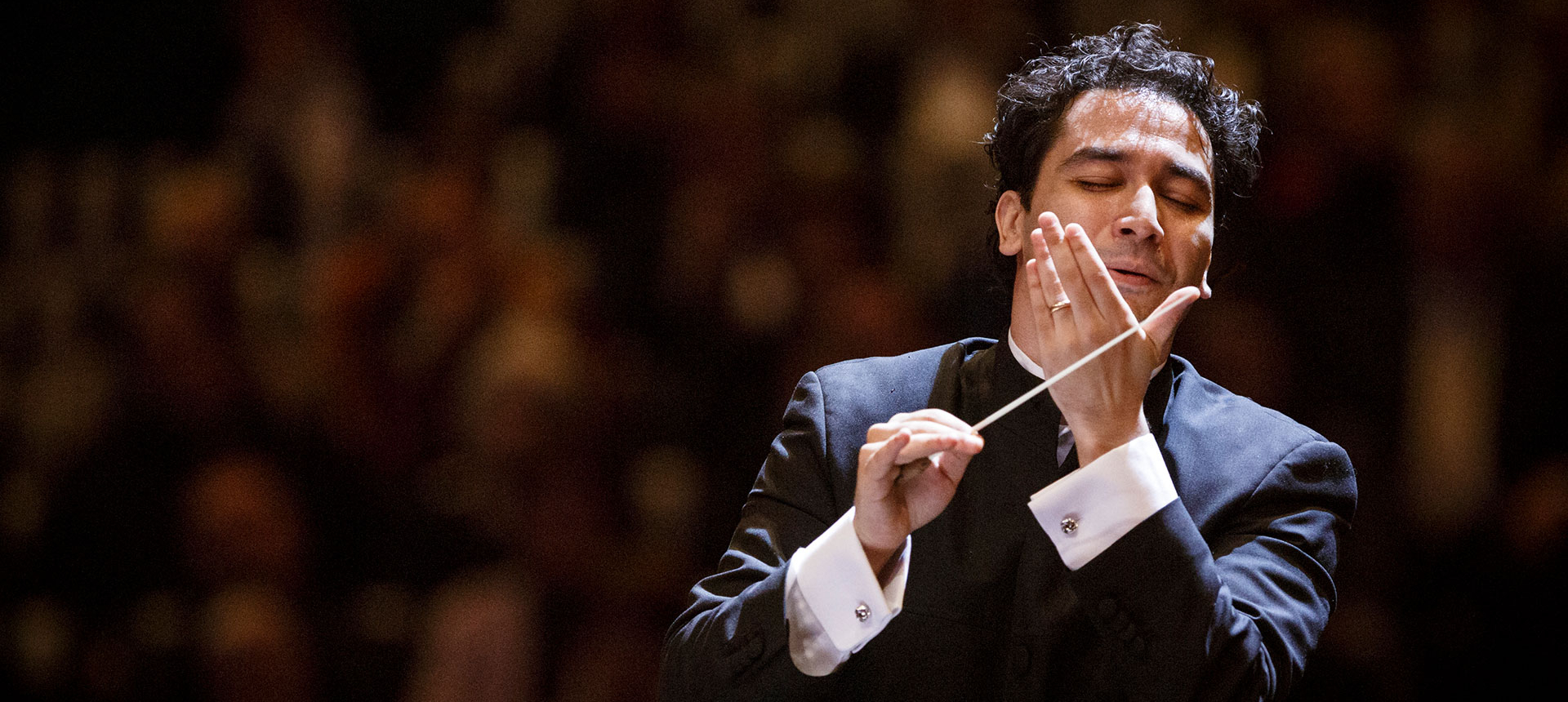
The Gothenburg Symphony brings out the biggest drum in a requiem for our time. This “opera in church dress” requires great expressions with choir and soloists. Giuseppe Verdi could set tumult, fury and regret like no one else. Hotly requested Andrés Orozco-Estrada conducts.
Can you experience history’s most dramatic requiem live without getting the shivers? The bass drum goes through bone and marrow, the choirs rage and the four soloists step in from their toes to whisper in pianissimo the next moment.
Opera composer Verdi had all the tools to create an extremely effective requiem with a max. He had already written many successful operas with such good melodies that they were played and sung by street musicians and ordinary people. This made him a wealthy man. From producing a new opera every six to nine months, he took a sixteen-year hiatus from composing, with the exception of the Requiem, his personal interpretation of the Catholic mass.
The piece is performed more often in concert halls than in churches. No one has set the words “Deliver me”, “Wrath of God” and “Fearful King” to music more clearly. You may also recognize the music from the films Django Unchained, Mad Max: Fury Road and Armageddon.
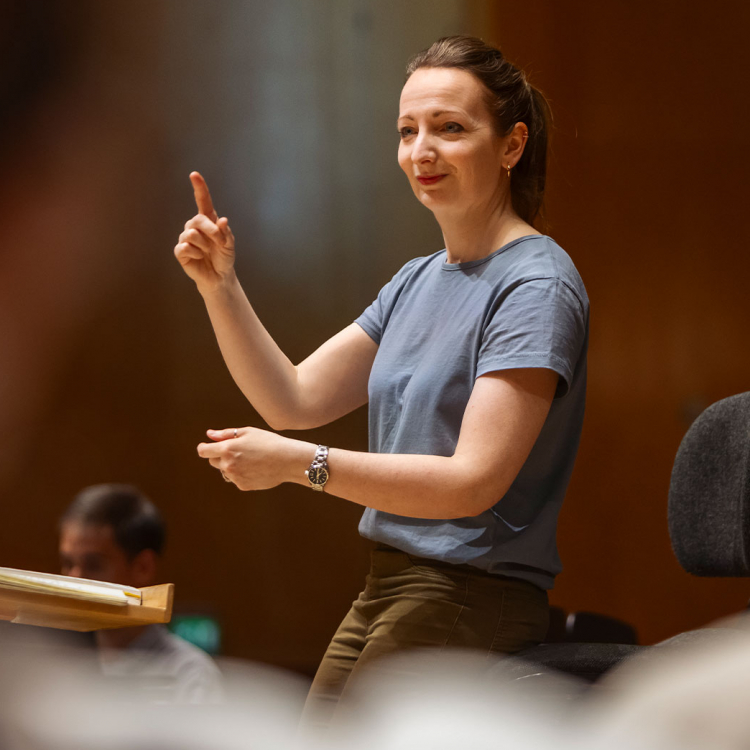
Colombian conductor Andrés Orozco-Estrada is one of today’s most sought-after conductors and has previously performed Verdi’s Requiem at the BBC Proms. Andrés Orozco-Estrada last visited the Gothenburg Symphony in 2019.
Autumn cosiness after concert 27 October
Right after Verdi’s Requiem on Friday 27 October, you are invited to mingle in the Götaplats foyer while the autumn evening descends. The bars are open and musicians from the Gothenburg Symphony set the mood as the autumn evening descends. The event takes place in connection with Kulturnatta. Free entry, open until 23.00.
Listen
Get toknow the classicalpieces.
Programme
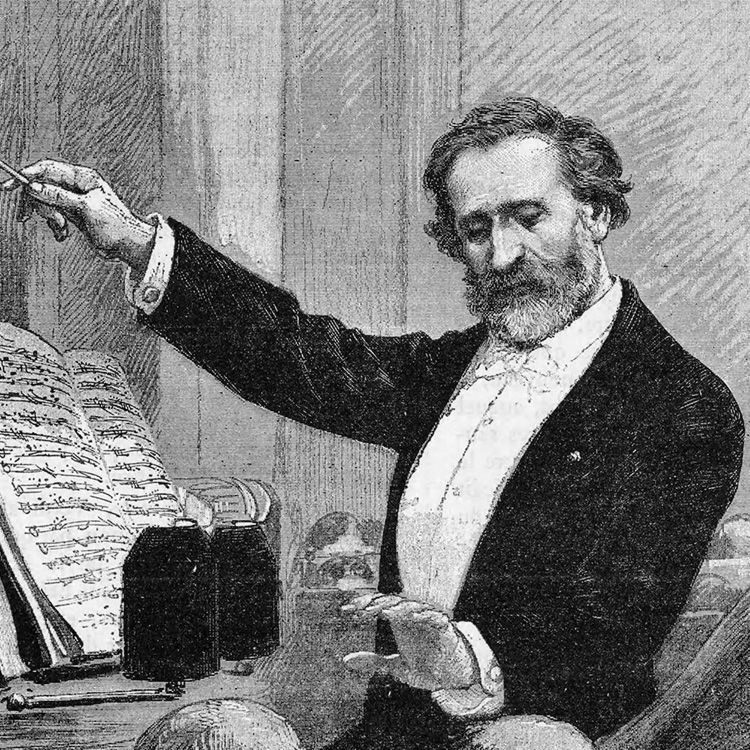
Giuseppe Verdi (1813-1901)
Missa da Requiem
Requiem et Kyrie - Dies irae - Offertorio - Sanctus - Agnus Dei - Lux aeterna - Libera me
Giuseppe Verdi has gone down in history as one of the foremost opera composers - he composed 28 operas and many of them are still part of the standard repertoire of opera houses. In addition to these grand scenic works, he wrote a string quartet, some romances and about ten church works with choir. But Verdi was definitely not a man of the church, on the contrary, as a free-thinking revolutionary, he was strongly critical of the Catholic Church's political and economic influence, and not least of the clergy. The fact that he nevertheless composed church music is rather related to the fact that he felt spiritual needs or wanted to pay tribute to loved ones. Along with Verdi, Rossini is one of the foremost Italian opera composers. They admired each other but were too different in temperament to be good friends. Even though Rossini as a composer had been silent for decades when he died in 1868, Verdi realized that the world had now become significantly poorer. To pay tribute to his predecessor, Verdi suggested that among all the composers of Italy, they should draw lots for the task of composing each movement for a requiem, a death mass. The idea was received with enthusiasm, but unfortunately the lot fell only on second and third-rate composers, composers who today are completely forgotten. The only exception was Verdi himself, and he composed the finale Libera me - music that soars above the other contributions. The project did not get off to a good start and in the end became so full of intrigue and difficulties that Verdi withdrew to begin work on Aida instead. But he thought the Libera me clause was too good to be forgotten. With no particular goal in mind, he therefore began to write the first and second episodes of his own obituary.
In 1873 one of the people Verdi admired the most died: the poet, statesman and humanist Alessandro Manzoni, aged 88. He was also admired by Lord Byron, Goethe, Balzac and many others. Verdi had not dared approach the idol, but through the wily intervention of his wife was once brought face to face with him, and he was overwhelmed by the encounter. Manzoni lay in state in Milan's city hall for several days and was given a state funeral. Verdi was unable to prove the funeral but now found reason to complete his on started obituary. He offered the municipal government of Milan to compose, print and lead the performance of the work without compensation - and on the anniversary of the poet's death (May 22, 1874) Verdi conducted his mass in St. Mark's Church in Milan with such great success that already three days later it was performed at new, but then in the La Scala opera. Three more performances followed in quick succession in Milan, seven at the Théâtre-Italien in Paris, four at the Hofoper in Vienna and three at the Royal Albert Hall in London - all conducted by Verdi himself. The audience was generally overjoyed and, to the chagrin of pure Catholics, cheered and applauded the performances. Many thought that the opera took too big a step into this work, and thus into the church. Yes, it was suggested that this was one of Verdi's best operas! Others argued the opposite. One thing is clear: it is an extremely dramatic work written by Verdi and he has treated the liturgical text with great freedom. At the same time, he also reveals great erudition in his allusions to older Italian church music, all the way back to Gregorian chant.
The work begins softly and deeply with Requiem, "rest", before the central movement of the death mass, Dies irae, takes over with its doomsday trumpets and outbursts of anger. The offertory is performed by the soloist quartet and the Sanctus is an eight-part double fugue. Many consider the Agnus Dei to be the heart of the Mass and the Lux aeterna is a brightly radiant prayer that anticipates the concluding Libera me to which the soprano responds. Verdi's Requiem is one of the most grand and moving works of its genre, and it has maintained its popularity for well over a century.
Friday, 27 October 2023: The event ends at approx. 19.30
Saturday, 28 October 2023: The event ends at approx. 16.30
Participants
The Gothenburg Symphony was formed in 1905 and today consists of 109 musicians. The orchestra's base is Göteborgs Konserthus, the funk gem at Götaplatsen that has gathered music lovers since 1935. Since the 2017-2018 season, Santtu-Matias Rouvali has been Chief conductor of the Gothenburg Symphony. Since the 2019-2020 season, Barbara Hannigan is Principal guest conductor. We are also a proud partner of Barbara Hannigan's Equilibrium mentoring program focusing on young singers at the start of their careers.
Wilhelm Stenhammar was the orchestra's chief conductor from 1907 to 1922. He gave the orchestra a strong Nordic profile and invited colleagues Carl Nielsen and Jean Sibelius to the orchestra. Under the direction of conductor Neeme Järvi from 1982-2004, the orchestra made a series of international tours as well as a hundred disc recordings and established themselves among Europe's leading orchestras. In 1996, the Swedish Riksdag appointed the Gothenburg Symphony as Sweden's National Orchestra.
In recent decades, the orchestra has had prominent chief conductors such as Mario Venzago, Kent Nagano and Gustavo Dudamel. Sten Cranner is CEO and artistic director, Gustavo Dudamel honorary conductor and Neeme Järvi chief conductor emeritus. The orchestra's owner is the Västra Götaland Region.
The Gothenburg Symphony works regularly with conductors such as Herbert Blomstedt, Joana Carneiro, Jukka-Pekka Saraste, Christian Zacharias and Anja Bihlmaier.
Andrés Orozco-Estrada is designated conductor of the City of Cologne and Gürzenich-Kapellmeister from 2025-2026. He was principal conductor of the Frankfurt Radio Symphony Orchestra 2014-2021, and the Frankfurter Rundschau wrote: "… it is precisely the combination of dancelike playfulness and an unconditional search for perfection that obviously distinguishes the Colombian's work." He led the Houston Symphony Orchestra as Music Director from 2014-2022 and was also Chief Conductor of the Vienna Symphony Orchestra.
Orozco-Estrada regularly conducts Europe's leading orchestras, including the Vienna Philharmonic, the Berlin Philharmonic, the Sächsische Staatskapelle Dresden, the Gewandhausorchester Leipzig, the Koninklijk Concertgebouworkest, the Orchestra dell'Accademia Nazionale di Santa Cecilia and the Orchestre National de France, as well as major U.S. orchestras such as the Chicago Symphony Orchestra and the Philadelphia Orchestra. He has also conducted concerts and opera performances at the Berlin State Opera and the Salzburg Festival with outstanding success.
Guest conducting engagements in the recent seasons has taken him to the Boston Symphony Orchestra, the London Philharmonic Orchestra, the Gewandhausorchester Leipzig, the Staatskapelle Dresden, the NDR Elbphilharmonieorchester, the Budapest Festival Orchestra, the Oslo Philharmonic, the Orchestre National de France, and the Israel Philharmonic.
Born in Medellín, Colombia, Andrés Orozco-Estrada began his musical education by playing the violin. In 1997 he moved to Vienna, where he was accepted into the conducting class of Uroš Lajovic at the renowned Hochschule für Musik und Darstellende Kunst. He has now a professorship in orchestral conducting at the Hochschule.
She is not only namesake of one of Sweden's earliest opera stars, but also one of today's most praised young singers. Christina Nilsson has started the season with her role debut as Chrysothemis in Elektra at the Swedish Royal Opera. Another acting debut awaits in the spring when Christina appears as Elisabeth in Tannhäuser at Oper Frankfurt. The season also includes several concert productions, including Beethoven 9 with the Tokyo Metropolitan Symphony Orchestra and Bruckner's Te Deum with the Atlanta Symphony Orchestra and the London Symphony Orchestra led by Nathalie Stutzmann.
In the 2017-2018 season, Christina Nilsson had her big breakthrough with her notable role debut as Aida at the Swedish Royal Opera. She was also a soloist during the Stockholm Concert Hall's Trettondagskonsert. The following season, Christina Nilsson sang her first Ariadne in Strauss's Ariadne auf Naxos at Oper Frankfurt, which was followed by the same role at the opera in Lausanne, Switzerland. She also made a guest appearance as Aida at the Irish National Opera in Dublin.
Christina Nilsson, who comes from Ystad, won third prize in 2019 in the major international competition Operalia, where she was also awarded the competition's Birgit Nilsson Prize. In 2017, Christina was named winner of The Renata Tebaldi International Voice Competition. She also participated in the finals of the prestigious Neue Stimmen competition that same year. In 2016, she won both First Prize and Audience Prize in the Wilhelm Stenhammar International Music Competition.
In the 2019-2020 season, Christina Nilsson made her role debut as Elsa in Lohengrin at the Opernhaus Dortmund, which was followed by another role debut, this time at the Royal Opera where she appeared as the Countess in The Marriage of Figaro. In 2020, she sang the role of Aida in a concert version of the opera at the Deutsche Oper in Berlin and appeared in the Bolshoi and Plácido Domingo: Life in Opera gala concert that took place at the Bolshoi Theater in Moscow. In the spring of 2022, Christina Nilsson was currently in two productions at the Royal Opera. She appeared as the Countess in the new premiere of The Marriage of Figaro and then followed the title role in Aida.
The mezzo-soprano Katarina Karnéus is educated at Trinity College of Music and the National Opera Studio in London. In 1995 she won the BBC Cardiff Singer of the World Competition. She has worked with leading conductors such as Sir Simon Rattle, Sir Charles Mackerras, Sir Mark Elder, Sir Roger Norrington, Sir Antonio Pappano, Michael Tilson Thomas, Franz Welser-Möst and Ivor Bolton.
Among her opera engagements are appearances at the Metropolitan, Covent Garden, the Gothenburg Opera, the opera houses in Stuttgart, Frankfurt and Barcelona as well as Glyndebourne's gala. As a concert singer, she has worked with the Berlin Philharmonic, the NDR Orchestra in Hamburg, the Vienna Symphony and the San Francisco Symphony, as well as appearing at the BBC Proms and the festivals in Edinburgh and Salzburg. She has also given concerts at Wigmore Hall, Concertgebouw, Lincoln Center and La Monnaie as well as at international festivals.
Katarina Karnéus belongs to the soloist ensemble at Gothenburg Opera. She was appointed court singer in 2018.
Adam Frandsen is a Danish tenor who graduated in 2013 from the prestigious Curtis Institute of Music in Philadelphia USA and has quickly gained international attention. He appears this season in the role of Cavaradossi
in Tosca at Wermland Opera. Among his later engagements can be mentioned Don Ottavio in Don Giovanni in Auckland, New Zealand, the title roles in Don Carlos and Idomeneo and the tenor part in the song cycle in Dichterliebe at Folkoperan. He has also recently sung the role of Jenik in The Bartered Bride at Gothenburg Opera.
Other later roles are Rodolfo in La Bohème at the National Taichung Theater in Taiwan, Augustin Moser in Die Meistersinger von Nürnberg at the Salzburg Easter Festival in Austria, Edgardo in Lucia di Lammermoor at Opera Hedeland, Alfredo in La Traviata at Jyske Opera, Young Servant in Elektra and Narraboth in Salome at the Royal Opera House Covent Garden, as well as the tenor part in Verdi's Requiem with the Victoria Symphony in Canada.
Frandsen was a regional finalist in the Metropolitan Opera National Council Auditions in 2008 and is the recipient of the Aalborg Opera Prize in 2015.
Bass Tareq Nazmi is from Munich and began his stage career at the opera studio of the Bavarian State Opera. In recent years, he has appeared at The Metropolitan, at the Bavarian State Opera, the Salzburg Festival and Theater St. Gallen among several other scenes. He has performed the role of Banco in Verdi's Macbeth in Antwerp and made a concert tour under the direction of Teodor Currentzis with Verdi's Messa da Requiem and Beethoven's Missa Solemnis under Kirill Petrenko in Munich. In addition, he toured Europe as Pope Clement VII in a concert version of Benvenuto Cellini, with Sir John Eliot Gardiner conducting. Tareq Nazmi's varied concert repertoire ranges from Bach to Beethoven, Haydn, Brahms, Mozart and Dvorák. He has worked with the Washington National Symphony Orchestra and Christoph Eschenbach, the Orchestre de Paris and Daniel Harding, performed in Brahms' Requiem in San Sebastian under Jukka-Pekka Saraste and in Mozart's Requiem with the Deutsches Symphonie-Orchester under Manfred Honeck in Berlin.
The choir was founded in 1917 by cousins Elsa and Wilhelm Stenhammar. Elsa Stenhammar was one of the driving forces in turn-of-the-century choir life in Gothenburg and became the choir's first rehearser. On December 8, 1917, the choir debuted in Beethoven's Choir Fantasy with Wilhelm Stenhammar as soloist at the grand piano. As the country's oldest symphonic choir, they were able to celebrate their 100th anniversary in 2017 with a big celebratory concert where Mozart and Brahms as well as Stenhammar, Elfrida Andrée and Björn & Benny were on the program.
The Gothenburg Symphony Choir is a non-profit association that is linked to the Gothenburg Symphony. The choir participates in concerts and performances under both the orchestra's and its own auspices. The music is mixed and the repertoire extensive. The Gothenburg Symphony Choir has participated in concerts in, among other places, the Royal Albert Hall and Canterbury Cathedral in England, as well as participated with the Gothenburg Symphony in the annual music festival in the Canary Islands and on a tour to China.
 031-726 53 00
 biljett@gso.se