Göteborgs Konserthus
Autumn mood with Poulenc’s Stabat Mater
Event has already taken place. A sincere and beautiful concert with the Gothenburg Symphony Orchestra; Aivis Greters, conductor; Johanna Wallroth, soprano; Gothenburg Symphony Vocal Ensemble and the Gothenburg Symphony Choir.
Concert length: 2 h incl. intermission
Stage: Stora salen
390-550 SEKStudent 195-275 SEK
Young up to 29 195-275 SEK
With his native country Latvia as a jumping-off point, conductor Aivis Greters guides us on a musical meditation. The beautiful word Lacrimosa means tearful, and refers to the farewell from Mary to Jesus on the cross. Like Mozart and many others, composer Arturs Maskats has set this powerful scene to music in his own way. Maskats dedicated his work to the victims of Estonia, on the anniversary of the sinking in 1994
Francis Poulenc’s popular choral work Stabat Mater also revolves around farewell, and the French master’s feel for melody and organic harmonies is truly on display here. This music is a contemplation on the eternal love evidenced by sorrow.
Performing the solo is well-known soprano Johanna Wallroth, acclaimed for her resonant, elegant style.
Jean Sibelius’ second symphony was inspired by the warmth of Italy, but with undertones of longing for his native Finland – for light summer nights and the lifelong love of nature in the Nordic region. The evening concludes with the heroic final movement, leaving the audience feeling hopeful and re-energised.
Listen
Get to know the music.
Introduction to the concert
Take a seat in the Great Hall onehourbefore the concertbegins and learnmoreabout the musicyouwillsoonexperience! Youwill get the storiesbehind the music, knowledgeof the composers and ownreflectionsabout the classicalpieces. The introductionlast for about 30 minutes, it is free and freeseating in the hall. Welcome!
Programme
Arturs Maskats (b 1957)
Lacrimosa
30 years ago, in the fall of 1994, we received tragic news of the sinking of ship Estonia in the Baltic Sea, which led to the loss of more than 800 lives. Latvian composer Arturs Maskats (1957), longtime director of the Latvian National Opera, dedicated his Lacrimosa for choir, organ and string orchestra to the victims of Estonia in 1995. The work was performed on the first memorial day of the sinking. Lacrimosa ("weeping") is one of the parts of the traditional death mass, and contemplates the human sorrow and plea for mercy in the face of death.
Lacrimosa is described as "the mystery of life and death" by Arturs Maskats himself. Celebrated for his emotionally rich compositions, he combines a lush harmonic language with expressive melodic lines, creating a deeply moving experience for the listener. His compositional style often mixes elements of neo-romanticism with modern textures, resulting in music that feels timeless and palpably fresh.
The work moves through a wide range of emotions between intimacy and grandeur - from quiet, personal grief to collective grief. The dynamic use of the choir and orchestra, where the voices often rise from the depths of sorrow to moments of purifying beauty, add to the poignant whole.
Francis Poulenc (1899-1963)
Stabat mater
Stabat mater is the 13th century text about the mother of Jesus who digs her heels in and refuses to leave her son's side as he dies on the cross. She can do nothing for him but this one thing, to stand there so that he can see her, to stand there until the end. The text has been set to music many times and it seems that it is precisely Mary’s stubborn, faithful loyalty that several composers take note of. Even Poulenc's Stabat mater begins that way. But there is nothing divine or exalted about Mary’s despair, it is a human suffering that everyone can recognize, everyone who has followed a loved one or relative to the edge of life. Similarly, Poulenc's setting of Stabat mater is a mixture of sadness, anger, weariness, resignation but also hope.
What prompted Poulenc to write the music was the death of his friend, the artist Christian Bérard, in 1949. Bérard, like Poulenc himself, was homosexual. It is clear that it was difficult for Poulenc to affirm his disposition at a time when it was forbidden, not least because he was also a devout Catholic. Poulenc, who suffered from manic depression throughout his life, had made a pilgrimage to the "black virgin" in Rocamadour in 1936. There he had a religious experience, even an epiphany. Perhaps it was only in the encounter with the statue of the Madonna with the baby Jesus in her lap that he was able to combine his faith in God with his way of life? When his friend Bérard died, he got the idea to write a Stabat mater in honor of Bérard.
The music Poulenc wrote before World War II was mostly lighthearted, but after his religious experience, Poulenc is often described as having a dual nature. He described his music in 1942 as follows: "I know very well that I am not one of those composers who have been tonally innovative like Igor, Ravel or Debussy, but I think there is room for new music that does not mind using other composers' tonality. Wasn't that how it was with Mozart-Schubert?”
Stabat mater was first performed in 1951 in Strasbourg and in the same year received the critics' prize in the USA as the best choral work of the year. Poulenc's Stabat mater reminds us of the deeply human thing that unites us all: the bitterness and incomprehensibility of death.
Peteris Butans (1942-2020)
Lux aeterna luceat eis: Movement 2
The Latvian composer Peteris Butans is mainly known for his many contributions to contemporary choral music. He was born in Daugavpils, Latvia's second largest city, and sought spiritual renewal, including influences from Latvian folklore.
Lux aeterna luceat eis (Let eternal light shine upon them), written in 2004, is a composition that reflects the deeply spiritual themes primarily associated with the Christian tradition. Lux aeterna is traditionally part of the Requiem Mass, usually performed as a prayer for eternal rest and peace after death.
Butan's interpretation of the text has a meditative quality where the timbres develop softly, allowing the choir to explore the nuances of the words. The music is a blend of rich harmonies and subtle melodic lines, creating a powerful sense of transcendence and peace. The compositional style is characterized by a minimalist expression with clear attention to vocal structure, and is often compared to composers such as Arvo Pärt.
From its simplicity, the piece's emotional weight is allowed to resonate deeply with the listener, creating an ethereal soundscape that lingers long after the final note has sounded.
Intermission25 min
Allegretto
Tempo andante ma rubato
Vivacissimo
Finale: Allegro moderato
After completing his higher studies in Berlin and Vienna, Sibelius wrote the choral work Kullervo on his return to Helsinki. The work's success earned him the position of Finland's leading composer, a position he retained for the rest of his life. A series of symphonic poems based on themes from Finnish mythology followed, and Sibelius came to play an important role in shaping Finnish national identity. He also became the driving force in the development of the Nordic symphony.
Sibelius had worshiped Tchaikovsky since childhood, but his schooling had forced him into a more Germanic tradition. Tchaikovsky's influence is nevertheless fully audible, not least in the first two symphonies. Especially in the second, like the idol, he builds up highlights with broad melodic lines and slowly shifting harmonics, and lets the music grow organically. The motifs are often built up gradually, where the theme repeats itself towards its final goal. This method he came to develop, and mastered it fully in the later third symphony. Like Beethoven, he renews his personal compositional technique and style with each new work.
The second symphony was begun in the spring of 1901 during a year's stay with the family in Rapallo outside Genoa, Italy. It is partly inspired by Dante's Divine Comedy but also by the fate of Don Giovanni in Mozart's opera of the same name. This gives it a dramatic-heroic character, which is clearly audible not least in the last movement. In the slow second movement, he even directly borrows the Commendatore's theme from Don Giovanni and also uses the same dark key that is the basic key of the opera, D minor. But the symphony also carries traces of Italy's warmth and sun in its tonality, and with a little imagination you can also sense an undertone of longing for the homeland of Finland, for the bright summer nights and the lifelong love of nature in the Nordics.
Despite Sibelius' habit of breaking down his themes into smaller components, something that sounded unusual at first to contemporary listeners, the symphony was nevertheless received with great enthusiasm. The work's underlying streak of patriotic pathos appealed to the Finns who thirsted for freedom from Tsarist rule.
Friend and conductor Robert Kajanus said of the work that he heard "the most heartbreaking protest against all the injustices that threaten our time" but also that it promised new possibilities in the future. Officially, Sibelius opposed this interpretation, possibly out of fear of censorship and reprisals, but it is very possible that the intention was there anyway. In the finale, an echo from Mussorgsky's opera Boris Godunov is heard in the viola and cello part, from the scene where the monk Pimen enumerates the crimes of Tsar Boris.
The ending is characterized by brilliance and rapture, and the music is lifted to bright heights - an ending that has few musical counterparts.
Andreas Konvicka
Friday, 8 November 2024: The event ends at approx. 20.00
Saturday, 9 November 2024: The event ends at approx. 17.00
Participants
The Gothenburg Symphony was formed in 1905 and today consists of 109 musicians. The orchestra's base is Göteborgs Konserthus, the funk gem at Götaplatsen that has gathered music lovers since 1935. Since the 2017-2018 season, Santtu-Matias Rouvali has been Chief conductor of the Gothenburg Symphony. Since the 2019-2020 season, Barbara Hannigan is Principal guest conductor. We are also a proud partner of Barbara Hannigan's Equilibrium mentoring program focusing on young singers at the start of their careers.
Wilhelm Stenhammar was the orchestra's chief conductor from 1907 to 1922. He gave the orchestra a strong Nordic profile and invited colleagues Carl Nielsen and Jean Sibelius to the orchestra. Under the direction of conductor Neeme Järvi from 1982-2004, the orchestra made a series of international tours as well as a hundred disc recordings and established themselves among Europe's leading orchestras. In 1996, the Swedish Riksdag appointed the Gothenburg Symphony as Sweden's National Orchestra.
In recent decades, the orchestra has had prominent chief conductors such as Mario Venzago and Gustavo Dudamel, following Kent Nagano as Principal Guest conductor. Anna-Karin Larsson is CEO and artistic director, Gustavo Dudamel honorary conductor and Neeme Järvi chief conductor emeritus. The orchestra's owner is the Västra Götaland Region.
The Gothenburg Symphony works regularly with conductors such as Herbert Blomstedt, Joana Carneiro, Jukka-Pekka Saraste, Christian Zacharias and Anja Bihlmaier.
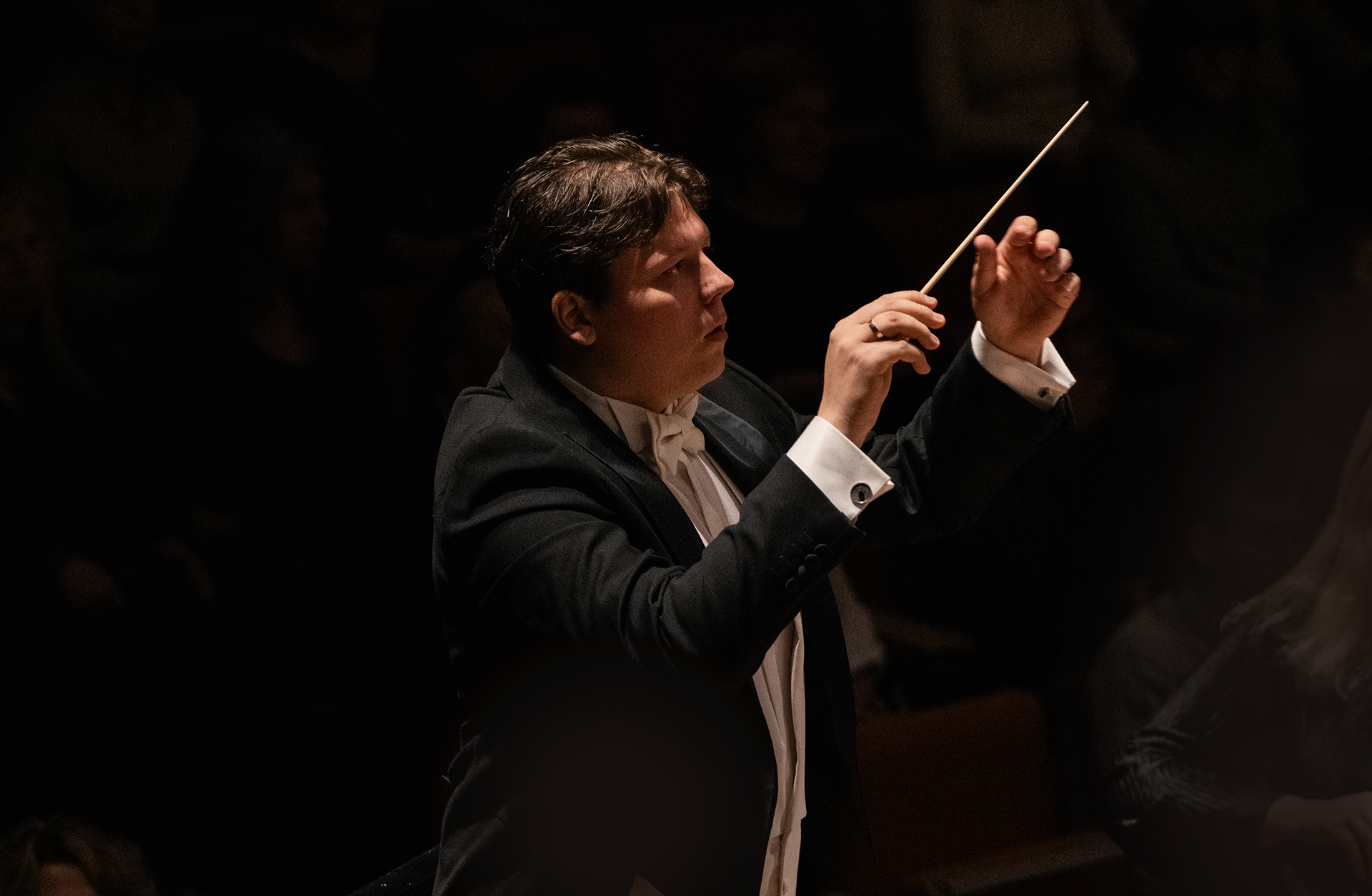
Hailed as one of the most exciting discoveries from the Baltics, young Latvian conductor Aivis Greters is from 2024 Principal Guest Conductor of the Gothenburg Opera. He will this season conduct Carmen and Iolanta, among others.
In the 2023-2024 season, at Gothenburg Opera he conducted a wide range of repertoire including Nabucco, Don Giovanni and Tosca. He debuted with orchestras such as the Norwegian Radio Orchestra, Bamberger Symphoniker and Deutsches Symphonie-Orchester Berlin. Greters started his musical career in 2018 as the artistic director and conductor of the Latvian youth choir Kamer. In 2021, Greters received Latvia's Grand Music Prize in Young Artist of the Year 2020 and the categories Artistic Bravery and Innovation under COVID-19 for projects with the choir at the Cesis Music Festival. In the 2020-2021 season, Greters debuted as a symphonic conductor with the three major orchestras in his home country: the Latvian National Symphony Orchestra, the Riga Sinfonietta and the Liepaja Symphony Orchestra.
Greters graduated from Jazeps Vitol's Latvian Academy of Music's orchestra conducting department and further developed his skills in 2015-2016 at the Royal Academy of Music in Stockholm.
Johanna Wallroth is one of the most prominent young sopranos in Europe and and was honoured with the prestigious Birgit Nilsson Scholarship in 2021. Following her remarkable debut as Zerlina in Mozart's Don Giovanni with Swedish Radio Symphony Orchestra and Music Director Daniel Harding, she was named Swedish Radio's Artist in Residence for the 2022 and 2023 seasons. From September 2023, Johanna Wallroth joined the BBC Radio 3 New Generation Artist Scheme further solidifying her status as an accomplished and exciting young artist.
In the 2020-2021 season, Johanna Wallroth joined the Opernstudio of Wiener Staatsoper for two seasons. She returned to Vienna's main stage in the 2022-2023 season as a guest artist where she joined Barrie Kosky's captivating new production of Le Nozze di Figaro, reprising her previous success as Barbarina under the baton of Philippe Jordan.
Wallroth’s recent debuts include Opernhaus Zürich, Drottningholm Theatre and the Internationale Barocktage Stift Melk with Stefan Gottfried and Concentus Musicus Wien. As Eurydice (Orfeo ed Eurydice) she performed at MDW Wien, as Despina (Così fan tutte), Gretel (Hänsel und Gretel) and Susanna (Le Nozze di Figaro) at Vienna’s Schlosstheater Schönbrunn, Pamina (Die Zauberflöte) at Moscow’s Gnesin Academy as well as both Sandmännchen and Taumännchen (Hänsel und Gretel) at Norrlandsoperan, Umeå.
In 2023-2024 season she toured Oslo Philharmonic and Klaus Mäkelä, she debuted with Orchestre de Paris in Mahler’s Symphony No.8 (Mater Gloriosa) under Daniel Harding, sang Nielsen’s Symphony No.3 with Swedish Radio Symphony Orchestra under Alan Gilbert and made first performances with Danish National Symphony Orchestra in Debussy La demoiselle elué under Barbara Hannigan. On the opera stage, Johanna Wallroth made debuts 2024 at both Opéra de Rouen as Zerlina under Ben Glassberg and at Glyndebourne Festival Opera as Cleopatra in David McVicar’s dynamic staging of Handel’s Giulio Cesare.
The Gothenburg Symphony Vocal Ensemble (GSVE) was formed in 2016 and consists of 12 professional singers. The ensemble works both as part of the Gothenburg Symphony Choir in major symphonic works performed together with the Gothenburg Symphony, and as an independent ensemble under the direction of Katie Thomas.
GSVE is a group of experienced and versatile singers, who perform varied programs and explore a wide repertoire, from medieval music to newly commissioned works. The ensemble has previously collaborated with, among others, the Helsingborg Symphony Orchestra and the Barockakademin Göteborgs Symfoniker and performs regular vocal programs both in Gothenburg's Concert Hall and around the Västra Götaland region.
The choir was founded in 1917 by cousins Elsa and Wilhelm Stenhammar. Elsa Stenhammar was one of the driving forces in turn-of-the-century choir life in Gothenburg and became the choir's first rehearser. On December 8, 1917, the choir debuted in Beethoven's Choir Fantasy with Wilhelm Stenhammar as soloist at the grand piano. As the country's oldest symphonic choir, they were able to celebrate their 100th anniversary in 2017 with a big celebratory concert where Mozart and Brahms as well as Stenhammar, Elfrida Andrée and Björn & Benny were on the program.
The Gothenburg Symphony Choir is a non-profit association that is linked to the Gothenburg Symphony. The choir participates in concerts and performances under both the orchestra's and its own auspices. The music is mixed and the repertoire extensive. The Gothenburg Symphony Choir has participated in concerts in, among other places, the Royal Albert Hall and Canterbury Cathedral in England, as well as participated with the Gothenburg Symphony in the annual music festival in the Canary Islands and on a tour to China.



 031-726 53 00
 biljett@gso.se